Researches on morphine. Pt. 2 / by S.B. Schryver and Frederic H. Lees.
- Samuel Barnett Schryver
- Date:
- [1901]
Licence: In copyright
Credit: Researches on morphine. Pt. 2 / by S.B. Schryver and Frederic H. Lees. Source: Wellcome Collection.
17/22 (page 577)
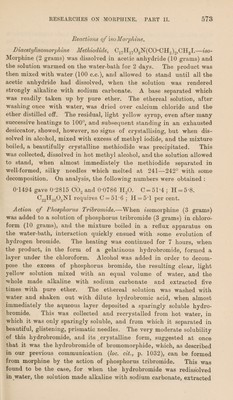
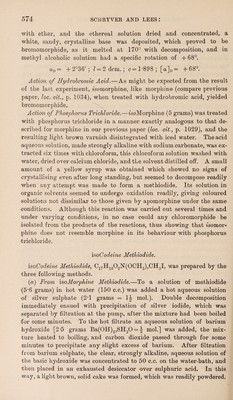
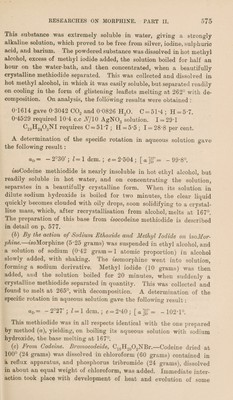
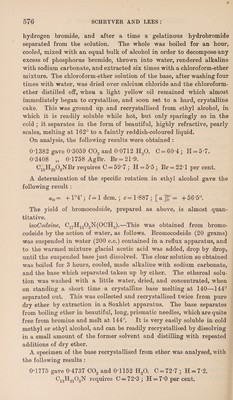
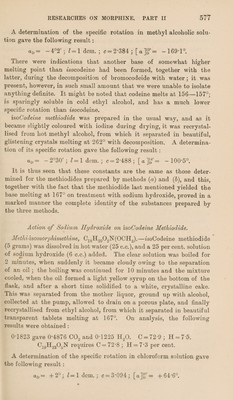
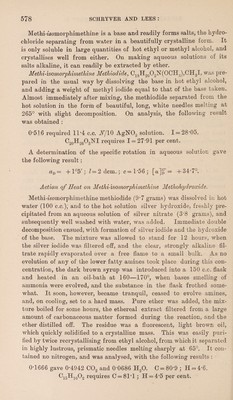
![A determination of the specific rotation in methyl alcoholic solu¬ tion gave the following result: aD = -4°2';J=1 dcm. ; c = 2‘384 ; [«]?= -169-1°. There were indications that another base of somewhat higher melting point than zsocodeine had been formed, together with the latter, during the decomposition of bromocodeide with water; it was present, however, in such small amount that we were unable to isolate anything definite. It might be noted that codeine melts at 156—157°; is sparingly soluble in cold ethyl alcohol, and has a much lower specific rotation than rsocodeine. iso Codeine methiodide was prepared in the usual way, and as it became slightly coloured with iodine during drying, it was recrystal¬ lised from hot methyl alcohol, from which it separated in beautiful, glistening crystals melting at 262° with decomposition. A determina¬ tion of its specific rotation gave the following result : aD= - 2°30'; 1=1 dcm.; c = 2-488; [a]j? = -100-5°. It is thus seen that these constants are the same as those deter¬ mined for the methiodides prepared by methods (a) and (b), and this, together with the fact that the methiodide last mentioned yielded the base melting at 167° on treatment with sodium hydroxide, proved in a marked manner the complete identity of the substances prepared by the three methods. Action of Sodium Hydroxide on isoCodeine Methiodide. Methf-isomorphimethine, C18H20O2N(OCH3).—rsoCodeine methiodide (5 grams) was dissolved in hot water (25 c.c.), and a 25 per cent, solution of sodium hydroxide (6 c.c.) added. The clear solution was boiled for 2 minutes, when suddenly it became cloudy owing to the separation of an oil ; the boiling was continued for 10 minutes and the mixture cooled, when the oil formed a light yellow syrup on the bottom of the flask, and after a short time solidified to a white, crystalline cake. This was separated from the mother liquor, ground up with alcohol, collected at the pump, allowed to drain on a porous plate, and finally recrystallised from ethyl alcohol, from which it separated in beautiful transparent tablets melting at 167°. On analysis, the following results were obtained : 0-1823 gave 0-4876 C02 and 0-1225 II20. C = 72-9; H = 75. CigHosO.N requires C = 72-8; H = 7-3 per cent. A determination of the specific rotation in chloroform solution gave the following result : aD= +2°; 1=1 dcm.; c = 3'094; [a]if= +64-6°.](https://iiif.wellcomecollection.org/image/b30600686_0017.jp2/full/800%2C/0/default.jpg)