Researches on morphine. Pt. 2 / by S.B. Schryver and Frederic H. Lees.
- Samuel Barnett Schryver
- Date:
- [1901]
Licence: In copyright
Credit: Researches on morphine. Pt. 2 / by S.B. Schryver and Frederic H. Lees. Source: Wellcome Collection.
19/22 (page 579)
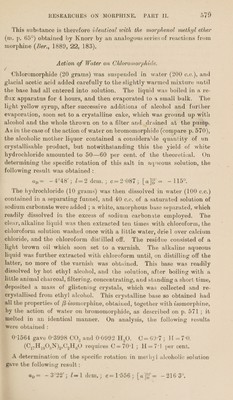
![This substance is therefore identical with the morphenol methyl ether (m. p. 05°) obtained by Knorr by an analogous series of reactions from morphine (2?er., 1889, 22, 183). Action of Water on Chloromorphicle. Ohloromorphide (20 grams) was suspended in water (200 c.c.), and glacial acetic acid added carefully to the slightly warmed mixture until the base had all entered into solution. The liquid was boiled in a re¬ flux apparatus for 4 hours, and then evaporated to a small bulk. The light yellow syrup, after successive additions of alcohol and further evaporation, soon set to a crystalline cake, which was ground up with alcohol and the whole thrown on to a filter and drained at the pump. As in the case of the action of water on bromomorpliide (compare p. 570), the alcoholic mother liquor contained a considerable quantity of un crystallisable product, but notwithstanding this the yield of white hydrochloride amounted to 50—60 per cent, of the theoretical. On determining the specific rotation of this salt in aqueous solution, the following result was obtained : aD= - 4°48'; 1= 2 dcm. ; c = 2'087; [a]£°= -115°. The hydrochloride (10 grams) was then dissolved in water (100 c.c.) contained in a separating funnel, and 40 c.c. of a saturated solution of sodium carbonate were added ; a white, amorphous base separated, which readily dissolved in the excess of sodium carbonate employed. The clear, alkaline liquid was then extracted ten times with chloroform, the chloroform solution washed once with a little water, driel over calcium chloride, and the chloroform distilled off. The residue consisted of a light brown oil which soon set to a varnish. The alkaline aqueous liquid was further extracted with chloroform until, on distilling off the latter, no more of the varnish was obtained. This base was readily dissolved by hot ethyl alcohol, and the solution, after boiling with a little animal charcoal, filtering, concentrating, and standing a short time, deposited a mass of glistening crystals, which was collected and re¬ crystallised from ethyl alcohol. This crystalline base so obtained had all the properties of /3-isomorphine, obtained, together with fsomorphine, by the action of water on bromomorphide, as described on p. 571 ; it melted in an identical manner. On analysis, the following results were obtained : 0*1564 gave 0-3998 C02 and 0 0992 11,0. C = 69 7; 11=7-0. (C17H19O8N)2,C2H0O requires 0 = 70*1 ; H = 7*l per cent. A determination of the specific rotation in meihyl alcoholic solution gave the following result:](https://iiif.wellcomecollection.org/image/b30600686_0019.jp2/full/800%2C/0/default.jpg)