The therapeutic value of the mixed toxins of the streptococcus of erysipelas and bacillus prodigiosus in the treatment of inoperable malignant tumors : with a report of one hundred and sixty cases / by William B. Coley.
- Coley, William Bradley, 1862-1926.
- Date:
- 1896
Licence: Public Domain Mark
Credit: The therapeutic value of the mixed toxins of the streptococcus of erysipelas and bacillus prodigiosus in the treatment of inoperable malignant tumors : with a report of one hundred and sixty cases / by William B. Coley. Source: Wellcome Collection.
Provider: This material has been provided by The Royal College of Surgeons of England. The original may be consulted at The Royal College of Surgeons of England.
11/34 page 9
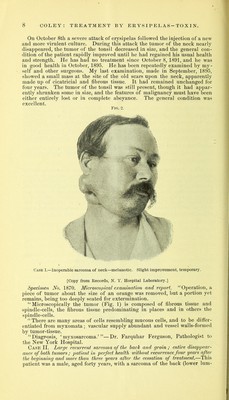
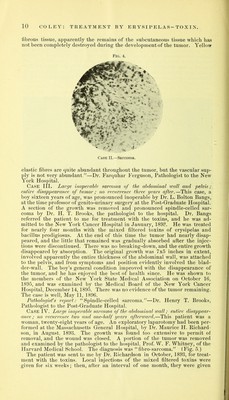
![bar region) 7x4 inches, with a secondary tumor the size of a goose-egg in the groin. The groin-tumor had been removed in January, but rapidly recurred. The patient was examined by Dr. William T. Bull, who regarded the case as inoperable sarcoma. The same diagnosis was made by a number of other surgeons. The tumor (Fig. 2) was photographed by Dr. George H. Fox, and a section was removed under cocaine and examined by Dr. Farquhar Fer- guson, pathologist to the New York Hospital, and the diagnosis confirmed. A full history of the case has already been published.^ Treatment was begun Fig. 3. Case II.—Sarcoma of back and groin. Well three and a quarter years after treatment. in the erysipelas-wards of Bellevue Hospital in April, 1892, and daily local injections of living bouillon-cultures of erysipelas were given for two weeks before an attack of erysipelas was produced. The attack was very severe, but during the attack and the few succeeding days both tumors entirely disappeared. Recurrence followed in July, and both tumors grew more rapidly than before. The injections were resumed, and between October, 1892, and January 1, 1893, he had four additional attacks of erysipelas, but mild in character. In December, 1892, he was exhibited before the Surgical Section of the New York Academy of Medicine. The infiuence upon the tumors was striking, but less marked and more temporary than the first attack. In January, 1893, I removed the recurrent back-tumor, but left the groin undisturbed. After three weeks there was an apparent recurrence in the back, and I began using the toxic products of erysipelas and bacillus prodigiosus, injecting them locally into the groin-tumor. This preparation was the one made by filtering toxins through porcelain. The two toxins were mixed at the time of using. The tumors quickly disappeared. The injections were discontinued in March, 1893, and the patient has been in perfect health ever since. (A pho- tograph was taken in April, 1896.)^ [Copy from Records, N. Y. Hospital Laboratory.] Pathological report. “ The tumor (Fig. 4) is a sarcoma, in which the cells are round, oval, and spindle, in which everywhere there is seen a stroma of 1 The American Journal of the Medical Sciences, July, 1894. 2 September 13,1896. The patient has a well-marked recurrence in the abdomen. He has rapidly lost flesh and strength the past few weeks.](https://iiif.wellcomecollection.org/image/b22453325_0013.jp2/full/800%2C/0/default.jpg)