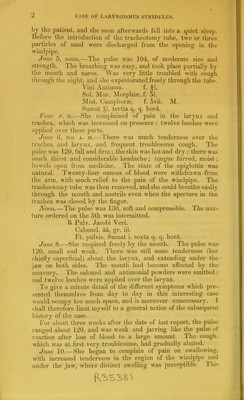
Case of laryngismus stridulus, in which tracheotomy was performed with success / by Alexander Fleming.
- Fleming Alexander, 1824-1875.
- Date:
- [1844?]
Licence: Public Domain Mark
Credit: Case of laryngismus stridulus, in which tracheotomy was performed with success / by Alexander Fleming. Source: Wellcome Collection.
Provider: This material has been provided by the Royal College of Physicians of Edinburgh. The original may be consulted at the Royal College of Physicians of Edinburgh.
1/4
![EXTRACTED ]<*ROM THE NORTHERN JOURNAL OF MEDICINE FOR DECEMBER 18i4. CASE OF LARYNGISMUS STRIDULUS, IiN WHICH TRACHEOTOMY WAS PERFORMED WITH SUCCESS. BY ALEXANDER FLEMING, M.D., Edinburgh, IPreaident of the Royal Medical Society, and House-surgeon in the Royal Infirmary of Edinburgh. Margaret Campbell, set. seventeen, a sei'vant, was admitted into Ward No. 3 of the Surgical Hospital on 4tli June, at half past eleven p. m.* It was stated by those who accompanied her to the house, that an hour and a half previously some sand had been thrown into her mouth by a boy, while she was in the act of inspiring. Water was procured for her with which to rinse the mouth ; but she had only time to do tliis once or twice, when she was seized with a severe fit of coughing, and difficulty of breathing ; and the latter, which was from the first characterized by par- nxysmal exacerbations, was gradually becoming more and more urgent. I may observe here that the patient afterwards stated that before admission she had coughed up several particles of sand. On admission, she was suffering from severe dyspnoea, aggravated in paroxysms, which recurred frequently. In the intervals between the paroxysms inspiration was prolonged and marked by a crowing sound, and expiration was attended with a harsh stridulous noise. The voice was very weak, and the fough had a pecuhar prolonged character. The face was l>ecoming hvid, and the pulse was very rapid, small, and weak. The epiglottis was carefully examined, and found to be perfectly natural and free from any particles of sand. The patient anxiously besought relief from what seemed to her im- })ending suffocation. Aa tracheotomy appeared to me to afford the only chance of ]>re3erving the patient's life, the operation was immediately performed; and a middle-sized tube was inserted into the aperture in the trachea. Immediate relief was experienced * This case occurred in the hospital practice of Dr HandysicUi f](https://iiif.wellcomecollection.org/image/b21696299_0003.jp2/full/800%2C/0/default.jpg)