Diseases of the heart / By John Cowan with chapters on the electro-cardiograph, by W.T. Ritchie and the ocular manifestations in arterio-sclerosis, by Arthur J. Ballantyne.
- Cowan, John, 1870-
- Date:
- 1914
Licence: Public Domain Mark
Credit: Diseases of the heart / By John Cowan with chapters on the electro-cardiograph, by W.T. Ritchie and the ocular manifestations in arterio-sclerosis, by Arthur J. Ballantyne. Source: Wellcome Collection.
Provider: This material has been provided by the Augustus C. Long Health Sciences Library at Columbia University and Columbia University Libraries/Information Services, through the Medical Heritage Library. The original may be consulted at the the Augustus C. Long Health Sciences Library at Columbia University and Columbia University.
32/484 page 6
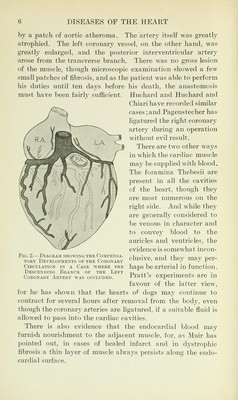
![by a patch of aortic atheroma. The artery itself was greatly atrophied. The left coronary vessel, on the other hand, was greatly enlarged, and the posterior interventricular artery arose from the transverse branch. There was no gross lesion of the muscle, though microscopic examination showed a few small patches of fibrosis, and as the patient was able to perform his duties until ten days before his death, the anastomosis must have been fairly sufficient. Huchard and Huchard and Chiari have recorded similar cases; and Pagenstecher has ligatured the right coronary artery during an operation without evil result. There are two other ways in which the cardiac muscle may be supplied with blood. The foramina Thebesii are present in all the cavities of the heart, though they are most numerous on the right side. And while they are generally considered to be venous in character and to convey blood to the auricles and ventricles, the evidence is somewhat incon- TiG. 2.—Diagram SHOWING THE CoMPENSA- pi,,„,Vp „.-,.] ^-v,p,, mav r^pr- TORY Developments of the Coronary cmsive, anci tne}' may per Circulation in a Case where the haps be arterial in function. Descending Branch of the Left p xj.5 , • j. , Coronary Artery was occluded. Jrratt S experiments are m favour of the latter view, for he has shown that the hearts of dogs may continue to contract for several hours after removal from the body, even though the coronary arteries are ligatured, if a suitable fluid is allowed to pass into the cardiac cavities. There is also evidence that the endocardial blood may furnish nourishment to the adjacent muscle, for, as Muir has pointed out, in cases of healed infarct and in dystrophic fibrosis a thin layer of muscle always persists along the endo- cardial surface.](https://iiif.wellcomecollection.org/image/b2122531x_0032.jp2/full/800%2C/0/default.jpg)