Towards an understanding of the mechanism of heredity / H.L.K. Whitehouse ; foreword by G. Pontecorvo.
- Harold Leslie Keer Whitehouse
- Date:
- 1969
Licence: Attribution-NonCommercial 4.0 International (CC BY-NC 4.0)
Credit: Towards an understanding of the mechanism of heredity / H.L.K. Whitehouse ; foreword by G. Pontecorvo. Source: Wellcome Collection.
57/480 page 36
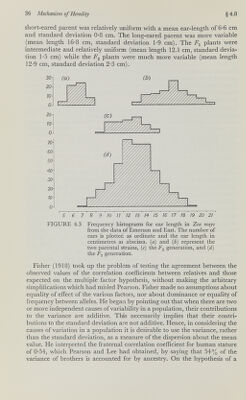
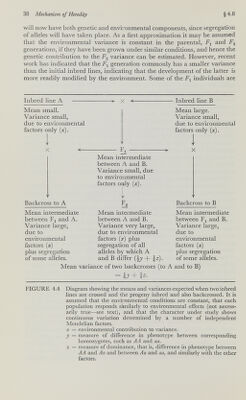
![36 Mechanism of Heredity §4.8 short-eared parent was relatively uniform with a mean ear-length of 6-6 cm and standard deviation 0-8 cm. The long-eared parent was more variable (mean length 16-8 cm, standard deviation 1-9 cm). The Fj plants were intermediate and relatively uniform (mean length 12.1 cm, standard devia¬ tion 1-5 cm) while the plants were much more variable (mean length 12-9 cm, standard deviation 2*3 cm). 5 6 7 8 9 Ю 11 12 13 Í4 15 16 17 18 19 20 21 FIGURE 4.3 Frequency histograms for ear length in Zea mays from the data of Emerson and East. The number of ears is plotted as ordinate and the ear length in centimetres as abscissa, (a) and {b) represent the two parental strains, [c] the generation, and [d) the F2 generation. Fisher (1918) took up the problem of testing the agreement between the observed values of the correlation coefficients between relatives and those expected on the multiple factor hypothesis, without making the arbitrary simplifications which had misled Pearson. Fisher made no assumptions about equality of effect of the various factors, nor about dominance or equality of frequency between alleles. He began by pointing out that when there are two or more independent causes of variability in a population, their contributions to the variance are additive. This necessarily implies that their contri¬ butions to the standard deviation are not additive. Hence, in considering the causes of variation in a population it is desirable to use the variance, rather than the standard deviation, as a measure of the dispersion about the mean value. He interpreted the fraternal correlation coefficient for human stature of 0-54, which Pearson and Lee had obtained, by saying that 54% of the variance of brothers is accounted for by ancestry. On the hypothesis of a](https://iiif.wellcomecollection.org/image/b18037094_0057.JP2/full/800%2C/0/default.jpg)