Thirty-sixth annual report of the directors of James Murray's Royal Asylum for Lunatics, near Perth. June, 1863.
- James Murray's Royal Asylum for Lunatics
- Date:
- 1863
Licence: Public Domain Mark
Credit: Thirty-sixth annual report of the directors of James Murray's Royal Asylum for Lunatics, near Perth. June, 1863. Source: Wellcome Collection.
36/112 (page 30)
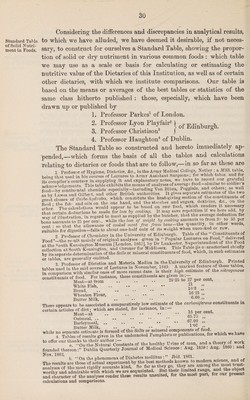
![so Considering the differences and discrepancies in analytical results, standard Table to which we have alluded, we have deemed it desirable, if not neoes- mentin Foods, sary, to construct for ourselves a Standard Table, showing the propor¬ tion of solid or dry nutriment in various common foods : which table we may use as a scale or basis for calculating or estimating the nutritive value of the Dietaries of this Institution, as well as of certain other dietaries, with which we institute comparisons. Our table is based on the means or averages of the best tables or statistics of the same class hitherto published : those, especially, which have been drawn up or published by 1. Professor Parkes1 of London. 2. Professor Lyon Playfair2 3. Professor Christison3 of Edinburgh. 4. Professor Haughton4 of Dublin. The Standard Table so constructed and hereto immediately ap¬ pended,—which forms the basis of all the tables and calculations relating to dietaries or foods that are to follow,—in so far as these are 1 Professor of Hygiene, Dietetics, &c., in the Army Medical College, Netley : a MSS. table, being that used in his courses of Lectures to Army Assistant Surgeons; for which table, and for its compiler’s courtesy in supplying it and explanatory notes, we have to record onr grateful acknowledgements. This table exhibits the means of analyses of average food—similar to soldiei s f00d_by continental chemists especially—including Von Bibra, Poggiale. and others; as well as bv I awes and Gilbeit. and other British authorities. It gives separate estimates of the two great classes of Carbo-hydrates, which constitute the heat-giving section of the constituents of food - the fat- and oils on the one hand, and the starches and sugars, dextiine, &c„ on the other The calculations would appear to be based on raw food, which renders it necessary that certain deductions be made for loss by cooking. It may save repetition if we here add, by wav of illustration in regard to meat as supplied by the butcher, that the average deduction for bone amounts to 25 per cent,., while the loss of weight by cooking> amountsi to from So to 35 per cent -“o that the allowance of cooked meat free from bone-the quantity in other words, suitable for digestion-falls to about one-half only of its weight when uncooked or raw. 2 Professor of Chemistrv in the University of Edinburgh. Table of the ‘‘Constituents of Pood”—the re-ult mainly of original analyses given in “Popular Lectures on I ood delivered at the South Kensington Museum [London. 1862], by Dr Lankester.^TaS^l^characterise^chTefly collection at South Kensington, and Coroner for Middlesex. This Table jis characterised cnieny by its senate determination of the Salts or mineral constituents of food, which, in such estimates or tables, are generally omitted. . , , 3 Professor of Dietetics and Materia Medica in the University of Edinburgh. Pririted tables used in the said course of Lectures in November, 1849. in comparison with similar ones of more recent date is their high estimate ot the nitrogenous constituents of food. For instance, these constituents are given mj- “ .. ** .. .. ‘ 21 „ . „ . 16-25 „ 6.60 ,, There appears t7be associated a comparatively low estimate of the carboniferous constituents in certain articles of diet; which are stated, for instance, in: Mgs.1)—at * • •• •• * * * * /vp. m- Oatmeal, .. .. •• •• •* ®'nn ” Barleymeal, .. .. •• •• ** ” Butter Milk •• •• •• •• t uu ,, wbllft no senavate estimate is formed of the Salts or mineral components of food. 1 4 Tables of results given in the undernoted Pamphlets or publications, for which we have to offerof the health, Drino ot man, and a theory ot work founded thereon:” Dublin Quarterly Journal of Medical Science : Aug. 1S59 . Aug. 1860 . d ft “ On the phenomena of Diabetes mellitus : Ibid. 1S61. , , „ The results are those of actual experiment by the best methods known to modern °f analyses of the most rigidly accurate kind. So far as they go, they are among the most tiust worthy and admirable with which we are acquainted. But t5eir ll“'fc^,r^5,e’ for our present and character of the analyses render these results unsuited, for the most part, for our present calculations and comparisons. Meat—at from White Fish, Bread, Wh eaten Flour, Butter Milk,](https://iiif.wellcomecollection.org/image/b30302316_0036.jp2/full/800%2C/0/default.jpg)