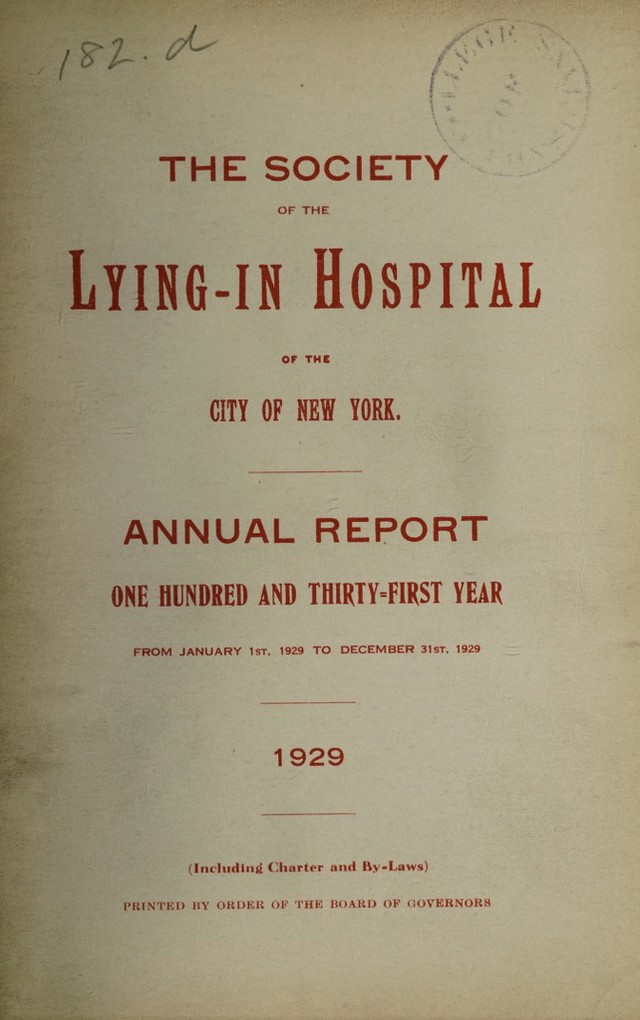
Annual report : 1929 / Society of the Lying-in Hospital of the City of New York.
- Society for the Lying-In Hospital
- Date:
- 1929
Licence: Public Domain Mark
Credit: Annual report : 1929 / Society of the Lying-in Hospital of the City of New York. Source: Wellcome Collection.
15/82 page 11
![demand for its services. Space does not permit of a history of the phenomenal changes and improvement in the teaching and practice of obstetrics which have taken place during the past forty years. In 1890, there were only a few out-patient obstetric departments in the country whereas now there are many. It is safe to say that there are one hundred or more hospital beds available now for maternity cases where there was but one at that time. Hundreds of medical students were graduated and began practice without any clinical knowledge whatsoever of obstetrics. Some twenty years ago an independent investigator reported that the Lying-In Hospital in New* York ranked fourth in the list of maternities of the world reckoned by the number of patients confined. The active work began on January 1, 1890, as the Midwifery Dispensary, with headquarters in two small tenements at No. 312 Broome Street. We had no telephone. As if to inculcate the idea that obstetricians should not sleep much or comfortably, the resident physician was provided with a bed which had been donated, and was much too short; the remainder of the staff and students being lodged in double deck beds. The fuel supply was gathered somewhat after the plan of the Israelites’ manna in the wilderness. Each week day, except Saturday, we bought a bucket of coal and a bundle of kindling. On Saturday the supply was doubled. Added to this there was a gas log in the office which sometimes functioned. Not infre¬ quently the entire staff were called out to active duty in the tene¬ ments and at such times the establishment was locked, a card being tacked on the door stating where the resident physician could be found. As stated, the work grew rapidly. One month we confined 357 women in the tenements. Later, with the in-door department, we treated in one year over seven thousand cases, sixty-three hundred of whom were confinements, and in the forty years this hospital has confined more than one hundred and seventy thousand women, some ninety thousand in their own homes. In fancy we sometimes see the many thousands of doctors, medical students and nurses who have been trained, and patients who have been treated in the Lying-In, gathered into one vast assemblage. To this number would be added children and grandchildren. Whatever its shortcomings, and we recog- [11]](https://iiif.wellcomecollection.org/image/b31710943_0015.jp2/full/800%2C/0/default.jpg)