A system of human anatomy, general and special / By Erasmus Wilson.
- William James Erasmus Wilson
- Date:
- 1843
Licence: Public Domain Mark
Credit: A system of human anatomy, general and special / By Erasmus Wilson. Source: Wellcome Collection.
Provider: This material has been provided by the Augustus C. Long Health Sciences Library at Columbia University and Columbia University Libraries/Information Services, through the Medical Heritage Library. The original may be consulted at the the Augustus C. Long Health Sciences Library at Columbia University and Columbia University.
570/596 page 556
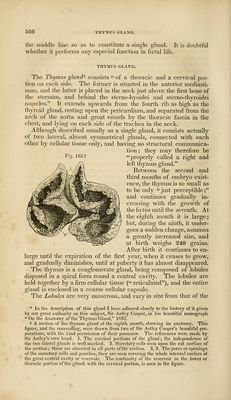
![the middle line so as to constitute a single gland. It is doubtful whether it performs any especial function in fcetal life. THYMUS GLAND. The Thymus gland* consists of a thoracic and a cervical por- tion on each side. The former is situated in the anterior mediasti- num, and the latter is placed in the neck just above the first bone of the sternum, and behind the sterno-hyoidei and sterno-thyroidei muscles. It extends upwards from the fourth rib as high as the thyroid gland, resting upon the pericardium, and separated from the arch of the aorta and great vessels by the thoracic fascia in the chest, and lying on each side of the trachea in the neck. Although described usually as a single gland, it consists actually of two lateral, almost symmetrical glands, connected with each other by cellular tissue only, and having no structural communica- tion ; they may therefore be ^'?-1^^''' properly called a right and left thymus gland. Between the second and third months of embryo exist- ence, the thymus is so small as to be only just perceptible; and continues gradually in- creasing with the growth of the foetus until the seventh. At the eighth month it is large; but, during the ninth, it under- goes a sudden change, assumes a greatly increased size, and at birth weighs 240 grains. After birth it continues to en- large until the expiration of the first year, when it ceases to grow, and gradually diminishes, until at puberty it has almost disappeared. The thymus is a conglomerate gland, being composed of lobules disposed in a spiral form round a central cavity. The lobules are held together by a firm cellular tissue ( reticulated), and the entire gland is enclosed in a coarse cellular capsule. The Lobules are very numerous, and vary in size from that of the * In the description of this gland I Iiave adliered closely to the history of it given by our great authority on this subject, Sir Astlcy Cooper, in his beautiful monograph On the Anatomy of the Tiiymus Gland, 1832, t A section of the tliymus gland at the eiglith montii, showing its anatomy. This figure, and tiio succeeding, were drawn from two of Sir Astley Cooper's beautiful pre- parations, with the kind permission of their possessor. The references were made by Sir Astlcy's own hand. 1. The cervical portions of the gland ; the independence of the two lateral glands is well marked. 2. Secretory cells seen u])on the cut surface of the section ; these are observed in all parts of the secti(jn. 3, 3. The pores or openings of the secretory cells and pouches, they are seen covering the whole internal surface of the great central cavity or reservoir. The continuity of the reservoir in the lower or thoracic portion of tlie gland, with the cervical portion, is seen in the figure.](https://iiif.wellcomecollection.org/image/b21203933_0570.jp2/full/800%2C/0/default.jpg)
 No text description is available for this image
 No text description is available for this image
 No text description is available for this image