Report of the Commissioners appointed to inquire into the regulations affecting the sanitary condition of the army, the organization of military hospitals, and the treatment of the sick and wounded ; with evidence and appendix. Presented to both Houses of Parliament by Command of Her Majesty.
- Great Britain. Royal Commission Appointed to Inquire into the Sanitary Condition of the Army.
- Date:
- 1858
Licence: Public Domain Mark
Credit: Report of the Commissioners appointed to inquire into the regulations affecting the sanitary condition of the army, the organization of military hospitals, and the treatment of the sick and wounded ; with evidence and appendix. Presented to both Houses of Parliament by Command of Her Majesty. Source: Wellcome Collection.
Provider: This material has been provided by London School of Hygiene & Tropical Medicine Library & Archives Service. The original may be consulted at London School of Hygiene & Tropical Medicine Library & Archives Service.
670/978 page 544
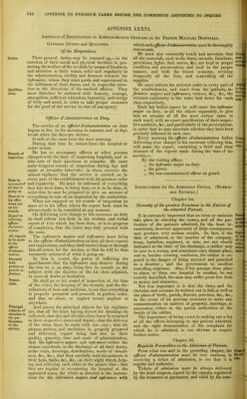
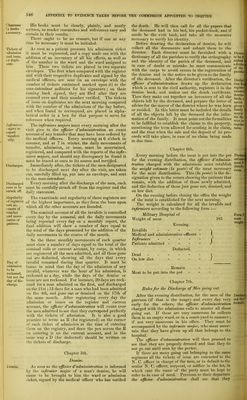
![APPENDIX LXXVI. Abstract of Instructions to Administbative Officers in the French Miijtary Hospitals. Duties. Qualifica- tions, Rounds of inspection. Must be intoi'mednf all that is going on. Must sit in his office ■when not on his rounds. Report to relieving officier d'ail minis- tratiun. All reports to be made to the officier d'arlminis- tration. Invested •with power.! to punish in- firmiers. Inspec- tions. Principal subjects of attention in the per- formance of the General Duties and Qualities. Of the Hospitallers. Their general duties may be summed up,—in the exertion of their moral and physical faculties in pro- moting the welfare of the invalids by means of kindness, and attention to their Avants, order and regularity in the administration, civility and firnniess towards the injirmiers, whom they must guide and superintend in the fulfilment of their duties, and in respectful atten- tion to the directions of the medical officers. They must therefore be endowed with honesty, courage, abnegation, sufficient education, ingenuity, and energy of body and mind, in order to take proper measures for the good of the service in case of emergency. Officier d'Administration on Duty. The service of an officier d'administration on duty begins at five in the morning in summer, and at day- break when the days are shorter. It ends at the same hour the next morning. During that time he cannot leave the hospital or retire to rest. He has to accompanj'- officers or other persons chai'ged with the duty of inspecting hospitals, and to take note of their questions or remarks. He must make frequent rounds of ins2:)ection during day and night at irregular intervals ; in short, exercise the utmost vigilance that the service is carried on in every part of the establishment with the greatest order and regularity. He must be informed of everything that has been done, is being done, or is to be done, in order that he may be prepared to give an account of everything in case of an inspection by the authorities. When not engaged on his rounds of inspection he must sit in his ofiice, where the report book must be always ready to be consulted at any moment. On delivering over charge to his successor on duty he shall inform him both in his written and verbal report of tliat which has been done, or is in progress of completion, that the latter may duly proceed with the same. The infirmiers majors and h^firmiers must bring to the officier d'adminislration on duty all their reports and requisitions, and they shall receive from or through hira all orders for the service, so that he Avill be thus constantly informed of what is going on. In him is vested the power of inflicting the punishments that the infirmiers may deserve during the time he is on dutj^, being fi-ee to consult on the subject with the director or the 1st class adjutant, in cases of doubt or hesitation. He shall go on liis round of inspection at the time of the visits, the dressing of the wounds, and the dis- tributions of food and medicine, to see that everything is properly prepared and proceeds in perfect order, and that no abuse or neglect occurs anyhow or anywhere. And among the principal objects for his vigilance are, that all the linen having served for dressings be collected; that this and all other dirty linen be returned to their res])ect.ive stores and depots ; that the delivery of the clean linen be made with due care ; that the ptisans, rations, and medicines be properly prepared and delivered, regard being had also to their quality, quantity, time and mode of administration; that the infirmiers majors and infirmiers evince the utmost exactitude in the discharge of all their duties, at the visits, dressings, distributions, works of cleanli- ness, &c., &c.; that they carefully tend the patients in their beds, baths, &c., &c.; at their night watch, help- ing and relieving each other at the proper time ; that tliey are regular in re-entering the hosjiit.al at the appointed times, the whole as detailed in the instruc- tions for the infirmiers majors and infirmiers with which each officier d'administration must be thoroughly conversant. He must also constantly watch and ascertain that all the materials, such as the linen, utensils, furniture, provisions, lights, fuel, stoves, &c., are kept in proper condition and preservation, and used in the proper manner, and with the wisest economy, revising frequently all the lists, and controlling all the supplies. He must enforce the strictest order in every part of the establishment, and exact frcnn the patients, in- firmiers majors and infirmiers, visitors, &c., &c., the strictest conformity to the rules laid down for each class respectively. Each day before sunset he will cause the infirmier major on duty, or all the others separately, to give him an account of all the most serious cases in each ward, Avith an exact specification of their respec- tive numbers, &c., and particularly of the prescriptions, in order that he may ascertain whether they have been precisely followed in each case. Every morning the officier d'administration before delivering over charge to his successor relieving him, will make his report, containing a brief and clear abstract of the reports made during the time of his service,— By the visiting officer. „ the infirmier major on duty. „ the porter. „ the non-commissioned officer on guard. Instructions for the Admission Office. (Bureau DES ENTRliES.) Chapter 1st. Necessity of the greatest Exactness in the Entries of the admitted Patients. It is extremely important that no error or omission take place in entering the names, and all the par- ticulars of the patients admitted, for the least in- exactitude, however apparently of little consequence, may produce very serious results. In fact, if the time of admission, or the number of the company, ti-oop, battalion, regiment, or arm, are not clearly indicated at the time of his discharge, a soldier may be sent to a Avrong, and sometimes very distant place, and so, besides creating confusion, the soldier is ex- posed to the danger of being arrested and punished as a deserter; and the government to needless travelling expenses. Also, if his passage from place to place, or from one hospital to another, be not exactly described, the man may suffer great loss both in money and character. Not less important is it that the dates, and the christian and surname be written out in full, as well as the place of birth, parish, district, province, &c., &c., in the event of its proving necessary to make any communication on matters of property, marriage, or succession, either to the parish authorities or the family of the soldier. The importance of being exact in making out a list of all the effects belonging to any patient admitted, and the right denomination of the complaint for Avhich he is admitted, is too obvious to require further notice. Chapter 2d. Requisite Formalities on the Admission of Patients. From Avhat Avas said in the preceding chapter, the officier d^administration must be very cautious, in receiving a ticket of admission, to see that it is regular and authentic. Tickets of admission must be ahvays delivered by the head surgeon, signed by the captain, registered by the treasurer or paymaster, and vised by the sous- Goo. and I servffi mate Adh to 1 for til] servim orde Com hens: repoi Impo of hs all pa cular minu' statec Fonnsi](https://iiif.wellcomecollection.org/image/b21365210_0670.jp2/full/800%2C/0/default.jpg)