Report of the Commissioners appointed to inquire into the regulations affecting the sanitary condition of the army, the organization of military hospitals, and the treatment of the sick and wounded ; with evidence and appendix. Presented to both Houses of Parliament by Command of Her Majesty.
- Great Britain. Royal Commission Appointed to Inquire into the Sanitary Condition of the Army.
- Date:
- 1858
Licence: Public Domain Mark
Credit: Report of the Commissioners appointed to inquire into the regulations affecting the sanitary condition of the army, the organization of military hospitals, and the treatment of the sick and wounded ; with evidence and appendix. Presented to both Houses of Parliament by Command of Her Majesty. Source: Wellcome Collection.
Provider: This material has been provided by London School of Hygiene & Tropical Medicine Library & Archives Service. The original may be consulted at London School of Hygiene & Tropical Medicine Library & Archives Service.
672/978 page 546
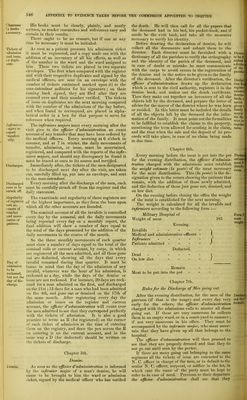
![Clearness i.i books I.ecessary. Tickets of •idmission iind issue, tT dupli- cate. 1 iifirmkrs- . lajors to 1 eport ransfers 'aily. Discharges. ] )ischarged men to be struck off. Jiegularily • if registers and ac- counts of number and move- :nents of patients. Day of ndmission to be reckoned, but not tbe day of dis- charge. itemise. His books must be clearly, plainly, and neatly written, to render researches and references easy and certain in their results. There ought to be no erasure, but if one at any time be necessary it must be initialed. As soon as a patient presents his admission ticket it must be registered, and a copy made out with the addition of an inventory of all his effects, as well as of the number in the ward and the ward assigned to him. These two tickets are placed in two separate envelopes. The first when compared with the register and with their respective duplicates and signed by the inedical officers, are sent (in an envelope with the number of tickets contained marked upon it) to the sous-intendant viilitaire for his signature ; on their coming back signed, they are filed after they are counted over and their number verified. The tickets of issue on duplicates are the next morning compared Avilh the number of the admissions of the day before, and when found to correspond, are placed in alpha- betical order in a box for that purpose to serve for reference when required. The infirmiers majors must every morning after the visit give to the ojficier d'administration an exact account of any transfer that may have been ordered by the medical ofiicers. Every morning at 6 o'clock in summer, and at 7 in Avinter, tbe daily movements of transfer, admissioia, or issue, must be ascertained, registered, and compared with the reports of the infir- miers majors, and should any discrepancy be found it must be traced at once to its source and rectified. Immediately after, the tickets of the men designated to be discharged next day after the visit, are taken out, carefully filled up, put into an envelope, and sent to the sous-intendant. Every morning after the discharge of the men, each must be carefully struck off from the i-egister and the daily statement. The exactitude and regularity of these registers are of the highest importance, as they form the base upon which all the other accounts are founded. The nominal account of all the invalids is controlled every day by the numeral, and the daily movements being reported every day on a monthly report, the final addition will show a number of days equal to the total of the days presented by the addition of the daily movements in the course of the month. So the three monthly movements of each quarter must shoAV a number of days equal to the total of the nominal rolls or current account, by corps, in which are registered all the men admitted, and all those gone out arc deducted, showing all the days that every invalid remained during that quarter. It must be borne in mind that the day of the admission of any invalid, whatever was the hour of his admission, is reckoned as a day, while the days of the demise or issue are not reckoned. For instance, 20 days are reck- oned for a man admitted on the first, and discharged on the 21st ; 13 days for a man who had been admitted on the 4th, and gone out or demised on the I7th of the same month. After registering every day the admission or issues on the register and current account, the officier d'administration will count over the men admitted to see that they correspond perfectly with the tickets of admission. It is also a good practice to Avrite an R (for registered) on the corner of each ticket of admission at the time of entering them on the registry, and dra^v the pen across the R on entering it on the current account, and in the same way a D (for deducted) should be written on the tickets of discharge. Chapter 5th. Demise. As soon as the officier d'administration is informed by the infirmier major of a man's demise, he will cause to be brought to him the ward or admission ticket, signed by the medical officer who has verified the death. He will then call for all the papers that the deceased had in his bed, his pocket-book, and if needs be the visit book, and take all the measures necessary to verify his identity. Before drawing the declaration of demise, he will collect all the documents and submit them to the director. Each director must be furnished Avith a dictionary of all the parishes to verify the orthography and the identity of the parish of the deceased, and in case of doubt or mistake he must communicate Avith the corps to avoid errors in the registration of the demise and in the notice to be given to the family of the deceased. After the director's verification, the officier d^administration draws up the declaration svhich is sent to the civil authority, registers it in the demise book, and makes out the death certificate. Then they make out together an inventory of all the objects left by the deceased, and prepare the letter of advice for the mayor of the district wlaere he Avas born or resided. In this letter must be included the details of all the objects left by the deceased for the infor- mation of the family. It must point out the formalities to be fulfilled to establish the claims to the property, mentioning the term allowed for sending in the claim, and the time when the sale and the deposit of its pro- ceeds Avill take place, in case of no claim being made in due time. Chapter 6th. Every morning before the meat is put into the jjot for the evening distribution, the officier d^adminis- tration charged with the admissions nmst establish the weight estimate {la pesee) of the meat necessary for the next distribution. This {la pesee) is the de- signation given to the return shoAving the patients that remain, Avith the addition of those newly admitted, and the deduction of those just gone out, demised, and on low diet. On the evening before closing the office the weight of the meat is established for the next morning. The weight is calculated for all the invalids and infirmiers according to the folloA\ang form :— Military Hospital of Weight of meat 185 Evening. Invalids . - - - . Medical and administrative officers - Infirmiers - Patients admitted - - - - } Deducted. Dead On low diet Remain Meat to be put into the pot - - - Chapter 7th. Rules for the Discharge of Men going out. After the evening distribution, for the men of the garrison (if that is the usage) and every day very early for the others, the officier d'administration charged with the admissions calls to muster all those going out. If these are very numerous he collects them in an empty Avard, or in a court-yard in summer; if not very numerous in his office. They must be accompanied by the infirmier major, Avho must ascer- tain that they haA^e given up all that belongs to the hospital. The officier d'administration will then proceed to see that they are properly dressed and that they do not go out until seen by the porter. If there are many going out belonging to the same regiment all the tickets of issue are entrusted to the N. C. officer in charge of the men, or in default to the senior N. C. officer, corporal, or soldier in the lot, in which case the name of the party must be kept to refer to in case of need. Previous to their departure the officier (Fadministration shall see that they Directi to be fi nisheij adictii of th( parisl Declai tion fi regiiti enten demi!^ book, notice](https://iiif.wellcomecollection.org/image/b21365210_0672.jp2/full/800%2C/0/default.jpg)