Report of the Commissioners appointed to inquire into the regulations affecting the sanitary condition of the army, the organization of military hospitals, and the treatment of the sick and wounded ; with evidence and appendix. Presented to both Houses of Parliament by Command of Her Majesty.
- Great Britain. Royal Commission Appointed to Inquire into the Sanitary Condition of the Army.
- Date:
- 1858
Licence: Public Domain Mark
Credit: Report of the Commissioners appointed to inquire into the regulations affecting the sanitary condition of the army, the organization of military hospitals, and the treatment of the sick and wounded ; with evidence and appendix. Presented to both Houses of Parliament by Command of Her Majesty. Source: Wellcome Collection.
Provider: This material has been provided by London School of Hygiene & Tropical Medicine Library & Archives Service. The original may be consulted at London School of Hygiene & Tropical Medicine Library & Archives Service.
712/978 page 586
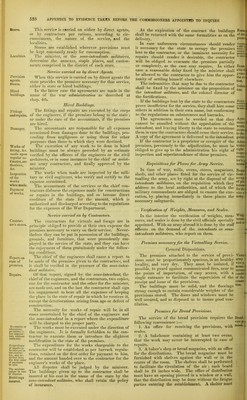
![Daraac^es, and p.iymtjut tli^reol, stated ;unl signed. l).^tai!od de- Bcript.ioa of \vorkB tJ be done. T r the officinr de ca-terneiitent refuses to afi- kno%vleil:;e the rtamai^es, the svork.s of re- pairs are pro- ceeded with nevtrrtheless. Orders for repairs are di- rectly trans- mitted to the contractors. Account of tne works done, ecrtitied ami jjaid, and chariied to the evacuating ■301'PS. Stoppage of the pay of the corps, to tl:e amount of onft-HirJi. to pay for damaues. Six moutji'? lime alhivvi-d !i_n!Uv.'liar- r.'H-k ijaniages cluu-i^es. A corpsleav- io.r without wcivnowledg- h\\i damages, the civil and military authorities ])roceed ex ofir'() to the verUication for tliem. Objects transmitted to a suc- ceeding ffarrison. Cleaning ■barracks oef jre deli- vering them. Tn case of iiurry an officer shall he left be- hind to see the bar- racks cleaned. Works of cleanliness if neglected ar3 ordered & charged as barrack damages. The corps re- ceives a dis- charge for the barracks, of which the keyB Damages and Payment. The engineer's guard ascertains the damages, the sous-intendant militnire makes out a statement, and the ojficier de casernetnent signs it. A detailed description of the works to be done is added by the engineer officer to the statement, with an approximate estimate of the outlay. Should the ojficier de casernement refuse to sign the statement, the sous-intendant militaire proceeds on, and the document is not the less executory against the corps evacuating. The orders for the repairs are immediately trans- mitted to the contractors for the military works. If the season permits, they are immediately executed, otherwise as soon as possible, on the terms of the contract approved by the minister. As soon as the works are done, the engineer officer certifies to them below the statement handed to the con- tractor, and joins to it a certified copy of the account of the works done. The contractor presents these docu- ments to the sous-intendant militaire, who causes the quartermaster-general or the paymaster-general to pay for them, putting the amount to the debit of the corps, to be stopped from the issue of the next pay. These stoppages can never exceed one-fifth ,of the whole pay at each time. Six months time are allowed to the corps for objections against such stoppages. No claim is entertained after such time has elapsed. If a corps leaves without the damages being ascer- tained and accounted for, the commandant of the place proceeds officially himself, or deputes an officer, or in his absence the mayor, or other member of the civil authority, is invited by the sous-intendant militaire to be present and represent the absent corps. In this case the local paymaster applies to the pay- master of the place where the corps resides, to cause the stoppage to be made. Objects for Transmission to the succeeding Garrison. The objects, such as forage carts, materials for the school of musketry, &c., &c., Avhich the corps buy and preserve on account of the fund of the corps, but must not take away on changing garrison, are left in charge with the guard of the engineers' appointed by his chief, to whom a duplicate inventory is also given. He, without entering them into his books of the material of his service, receives them in deposit, to remit them and account for them to the corps that succeeds, handing them one of the inventories, and getting on the other the discharge of his consignment. If on the 31st of December, which is the time for the production of the inventories of the materials, the barracks are still empty, the engineer Avill forward to the minister through his chiefs a certified dupli- cate of the same statement. On leaving the barracks, however hurriedly, or for whatever cause it may be, the corps must deliver all the rooms, corridors, staircases, stables, &c., in a perfect state of cleanliness, fit to receive immediataly the corps that succeeds. The commandant of the corps is responsible for that order to be executed. In case of a very precipitate departure, the officer in command shall leave behind an officer with a detachment, that shall proceed immediately to brush and clean every part of the buildings, stables, &c., which ha\ ing been done they will rejoin the corps. All the officers are obliged to deliver their quarters per- fectly clean for their successors. Any corps failing in the fulfilment of this duty shall have to pay for the cleaning of the barracks which shall be done immediately, by workmen hired by the engi- neer guard and the barrack-keeper, on the authority of the sous-intendant militoire, who will afterwards re- cover the cost as for the barrack damages. As soon as the sous-intendant militaire receives in- formation from the engineer guard of the delivery of the keys, he delivers to the corps a certificate exone rating them from any further responsibility for the arerctn lodgings they occupied, except as to the repairs to be gimrd. done for damages already ascertained. No part whatever of the barracks evacuated can be ^cSm retained for any time by any individual of the corps on^ny^fffi leaving, and every single key must be immediately | delivered by the ojfficier de casernement. leaving I Chapter 4th. Hiring of Lodgings. When the military buildings are found to be in- sufficient for the service, the sous-intendants militaires shall treat with private proprietors for the hiring of suitable places. When they cannot agree amicably with the proprie- tors, they must apply to the civil authorities, who shall interfere to procure them. The rent, in case of disagreement, shall be fixed by judicial arbitration. In case of urgency, the lodgings shall be occupied forthwith, and the rent shall be sttbsequently esta- blished and paid. No building can be hired without the authority of the Minister of War on an application of the inten- dant militaire, or a direct order from the intendant for the service of administration in case of urgency. When it is a question of quarters for the troops, the necessity for hiring these must be shown in a report {proces verbal) made out hy the sous-intendant with the chief of the engineers and the commandant of the place, where there is one. It must contain a description of the building, its conveniences, the price and conditions of the hiring. The intendaiit of the division adds to it his opinion, and presents it to the minister. A copy of that report should be sent to the director of the fortifications, that he may make his observa- tions if there is occasion for them. The special regulations of the different services of the administration determine the cases when the state is to take charge of the letting of the buildings intended for carrying out these services. For every kind of letting the agreements are drawn out by the sous-intendant with the officers of the engineers, and entered into between the war adminis- tration and the proprietor or his legal representative. They must be signed by the person that lets, the sous-intendant and the officer of the engineers, and vised by the intendant. The agreements must express : 1st. The date of the report of the suitableness of the premises. 2nd. The approving decision of the minister. 3rd. The kind, number, and extension of the premises. 4th. The service for which the premises are hired, and the particular use for which the premises are intended. 5th. The duration of the contract. 6th. The rent, the periods of the payments, and all the other conditions. They must mention the exemption from all the taxes, from which are exempted all the buildings occupied by the military or for which the employes shall pay as their lodgings. The agreements shall be as in Form No. 7. The agreements are made in three originals : One that the intendant transmits to the minister ; one for the proprietor ; and a third for the sous- intendant militaire, who causes two copies to be made, one for the divisional intendant and one for the chief of the engineers who was present at the stipulation, and put his signature to it. If the building is required for the administration, a third copy is delivered to the chief of the office. If contractors have to provide the premises, they shall stipulate in their own names. Hirii' lodgii . Civil ai i- rity sp] 11 in case nj culty ir taining ingB. Ariiitrfi It tix the : 0 lodging, Lodgini o) occupie r urgenc; id rent est blished T wards. Ami' foro. i°g loj ings. Necessi hiring! ingsto shown: applica with al tioulan latingt Intendi report: Copy repori sent t direct the fo cation mentg drawr and si Termf agree ments Dupli ( and d I of agr ► ments](https://iiif.wellcomecollection.org/image/b21365210_0712.jp2/full/800%2C/0/default.jpg)