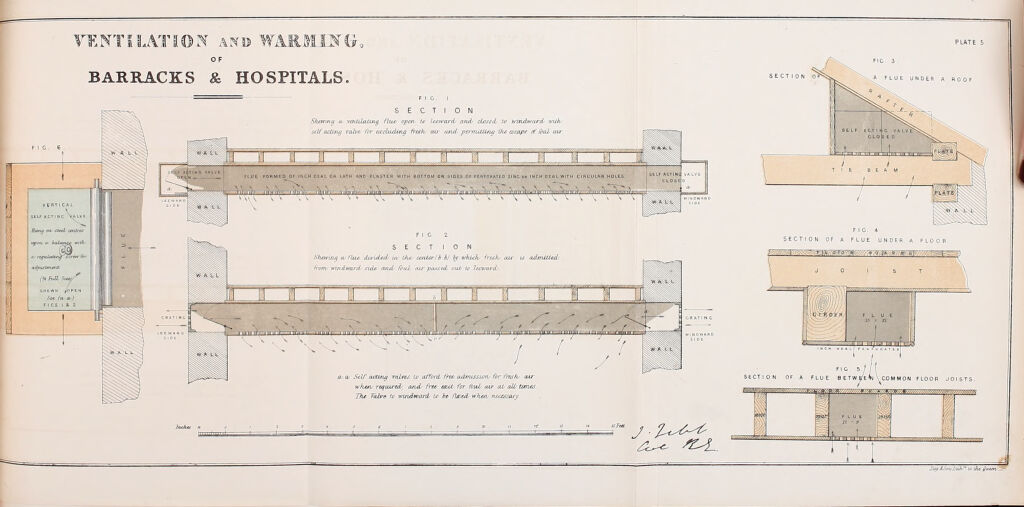
Report of the Commissioners appointed to inquire into the regulations affecting the sanitary condition of the army, the organization of military hospitals, and the treatment of the sick and wounded ; with evidence and appendix. Presented to both Houses of Parliament by Command of Her Majesty.
- Great Britain. Royal Commission Appointed to Inquire into the Sanitary Condition of the Army.
- Date:
- 1858
Licence: Public Domain Mark
Credit: Report of the Commissioners appointed to inquire into the regulations affecting the sanitary condition of the army, the organization of military hospitals, and the treatment of the sick and wounded ; with evidence and appendix. Presented to both Houses of Parliament by Command of Her Majesty. Source: Wellcome Collection.
Provider: This material has been provided by London School of Hygiene & Tropical Medicine Library & Archives Service. The original may be consulted at London School of Hygiene & Tropical Medicine Library & Archives Service.
732/978 page 600
![MEDICAL OFFICERS—co!i<. {Akxavder), 89H7.—Its duties {Alexander), 8987-9C05.—Ap- pointments at the Board should be for a specific period, as at the Horse Guards (Alcrandci ), 90) 3-22—Special appointments should he held for specitied periods (Mouat'), 9737-9.—Best form of government for A.M. department, a D.G. with a council to assist him (McNeill), 97G8.—The council should he nominated by tiie Minister of War {McNeill), 9793.— Organi- zation of Poor Law Board of Scotland (McNeill), 97G1-7.— Mode of conducting its 1)usiness (McA'eill), 97H5-7.—Consti- tution of the Madras government ( McNeill), 97G9.—D.G. should be a medical officer (McNeill), 9777.— All questions of import- ance should be discussed by the council (McNeill), 9775.— It is of essential importance that the grounds of their decisions should be recorded (McNeill), 9778-9.— Advantage from laying down definite rules (McNeill), 3790-2, Navy. Candidates.—Selected hy the Admiralty (Liddell), 190-1 Sufficient number of candidates (Liddell), 21'J, 15 Examined by the Director-General or a Board of M.O. (Liddell), 189 Examination oral and written, nearly the same as in the army (Liddell), 192-3.—Thinks the examina'ion a very )Hrfect test (Liddell), 195.—The rejections are numerous (/.»/</<■//), 197-200. — A course of military surgery not exacted (Liddell), 297-300. —No practical examination (Liddell), 194 A practical exami- nation would be advantageous (Liddell), 201.— No competitive examination (Liddell), 217.—There is a minimum of qualifica- tion (Liddell), 217.—No objection to a civil hoard of examiners but the Director-General should be present (Liddell), 263. Assistant-Surgeu7is,— Prefers th.nt they be first sent to a ship, and afterwards to a naval hospital (Liddell), 203-8, 315.— Learn hygiene on sliipboard ; no speciid instruction given (Liddell), 209-10.— After three years' service a certificiite is required of having performed all the capital operations of surgery (Liddell), 196, 226, 241-50.— Are not kept on full-pay while attending the course of practical surgery (Liddell), 237- 40, 316-18, 322.-—Pass an examination before promotion (Liddell), 220-5.— If abroad, there is a local Board to examine them (Liddell), 251.—Subsequently examined on return home (Liddfll), 252.—Has never known a rejection at the suliscquent examination (Liddell), 253.—Sometimes rejected at first (Liddell), 254.— Assistant.surgeon does not operate unless in charge; merely assists the surgeon (Liddell). 231-(i.— Dispenses on shipboard (Liddell), 345-7.—In naval hospitals there is a dispenser (Liddell), 348.—Many assistant-surgeons, and usually the best, resign the service (Liddell), 281-3. Department yeneralbj.—Ranks and numbers of (). {LI<1- fL'll), 259.—No. attached to lu)s))ilals abroad (Liddell), 473-8.— All ranks are executive (Liddell), 323.—^^The senior officer is both executive and administrative (Liddell), 386, 4C6-72, Pay.—Of naval M.O. (Lidde'l), 284-8. Prnmntinn.— Sufficient in the lower ranks, not in the higher (Liddell), 261.-—Is made by selection and seniority (Liddell), 262,312-13,414, 424 Director-General judges of the officers from personal knowledge and their medical reports (Liddell', 408-13—Receives no confidential reports upon them (Lidilell), 414.—Length of service before being eligible for promotion (Liddell), 416-KS. ifeaVemcni. —Compulsory (Liddell), 419-20, 431. E.I.Co.'s Service. Candidates.—Subject to approval of the President of the Board of Control ( I'arkes), 812.— Certificate of moral character required (Pnrkes), 814-17.—System of examination (Pugel). 674-80.—The examination is practical (Paget), 720-26, 757-8.—No examination in general knowledge (Payel), 682-4.—No special military medical examination (Paget), 690. — A minimum standard of acqiniement fixed (Paget), 697, 730. —The most general deficiency is in natural history (/^ai/ei), 680,717-19.—The (|ualifications of tlie candidates have in- creased (Paget), 685, 692-94; (Parlies), 761-64.—Relative number of vacancies and candidates (Paget), 711-14.—The inducements are sufficient to get the best men (Arnott), 8314. Assistant Surgeons.—Duties of (Arnoll), 8432-38. Regimental Siirgeoi.s.—Duties of (Arnott), 842-1-Sl. Superintending Surgeons.— Duties of (Arnutt), 8409-11, 8415-23. De/iartinevt generally. — Organization of the Indian Medical Department (Arnott), 8304.— Number of j\].0. in the Bombay Presidency (Arnoll), 8371.— Not sufficient (Arnott), 8331-32. — Native regiments have not a sufficient number of M.O. (Arnott), 8321-23. — System of appointments and promotions (Arnott), 8307-13.—' Average service before promotion (Arnott), I 8372-78. I Pay.—Emoluments satisfactory (Arnott), 8365-67.— System j of allowances in addition to pay (Arnott), 8637—12. , Rank.—Position of M.O. not satisfactory as regards relative rank (Arnott), 8333-64.—M.O. do not share fairly in the distribution of honours (Arnott), 8324-SO. MEDICAL OFFICERS—coH*. E.I.Co.'s Service—cont. Medical Board.—Constitution of (Arnott), 8309-11, 8415-23. —Duties of (Arnott), 8394-408. French Army. Qualifications demanded of candidates (Sutherland), i55S ; (Alexander), 4587.—The French government undertakes the education of the M.O. in the specialties of his profession (Salhcrland),'i?,59-6\. — Course of instruction at the Val de Grkca (Sutherland), 4353-58; [Ale.rander), 4587.—Organi- zation of the school at the Val de Grace (Alexander), 4587. Grades and relative rank of M. O.; ins))ectors, administra- tive officers—all other grades executive; appointments to regi- ments and hospitals ; promotion partly by selection and partly by seniority ; recommendations for promotion ; examination ou promotion; compulsory retirement ; sick leave to M.O. ; Council of Health of the Army (Alexander), 4587.—Consti- tution of (Balfour), 95?4. Belgian Army. Grades of M.O., system of promotion (Alexander), 4587. —Competitive examination for promotion (/^/exaxder), 4595-8. —Compulsory retirement (Alexander), 4587. SANITARY SCIENCE. Of great importance in the army (iSrorf/e), 593 ; (Parkes), 911-15; ('Taylor), 2330-40, 2388; (Farr), 7154-62.— Special instruction in sanitary science requisite (Sutherland), 9495, 9981 ; {McNeill), 99.56.—System of instruction in hygiene ill British and French schools ( 5'«;/i6TZa)ir/), 6550.— No special teaching of this science in tba army (Smith), 15, 41-5.—Nor in any branch of the public service {id.), 16.—• Nor in civil life (Fergusson), 661.—The technicalities of sanitary science are quite a modern thing (Hall), 5478-9.— Hyuicne forms part of every medical man's education (id.) 5609. — Great dilference in amount of sanitary knowledge possessed by difl'erent officers (Sutherland), 6578-9.—Desirable that it should be more general, {id.\ 6581, 6583-5. Military Hygiene. is professed to be taught in Edinburgh and Dublin ( Smith), 63.—The knowledge gained there is superficial (id.), 121- 22.—Professorships in Edinburgh and Dublin unnecessary (i'c/.), 71-2, 120; (Broun), 2805.— Injurious {Fergusson), 629-32 ; (Paget), 698-9.—Could be best taught in the chief military hosp;tal (Smith), 67, 123; (Rrodie), 516-17; (Paget), 700; (Alexander), 2465-6.— .And subsequently to admission into the service (Brodie), 525, 616-17; (Fer- gusson), 627 ; (Parhes), 776, 892-907 ; (Meyer), 956, 961-2, 1020-5; (iSroioO, 2801 ; (LLall), 5613.—Sanitary training in a military hospital essential (Brodie'', 600; ( Fergussort), 633-4; (Sutherland), 6551-65, 6568-75.—Lectures ou military hygiene should be estal)lished at Nelley ( 73; (Fergus- .lon), 6G0; (Brown), 2806; (Gibson), 9133-4; (McNeill), 9956-8. No manual of sanitary science exists (Smith), 47 ; (Parkes), 908.—Has long intended to write one, but lias failed from want of time (Smith), 56 Such a manual is a desideratum (Hall), 5619-21. —Works on hygiene hy army M.O. (id.), 5475-7.—No special naval manual of sanitary science (Liddell), 211. — Statistical reports partly supply the want (id.), 213.— A.M.O. were the first promoters of sanitary science (Suther- land), 6589.—A.M.O. are forced to become sanitary officers (Hall), 5471-4, 5511.—Have always been engaged in prevent- ing as well as treating disease (id.), 5482-4.—Have the knowledge requisite to make good sanitary officers (id.), 5489. — Are instructed to report upon the causes of disease among the troops (id.), 5485-8.— Are not sufficiently consulted or attended to in sanitary matters (Taylor), 2341-52, 2389 ; (.Alexander), 2706,2712-14; (Mansel), 4215-16; (Tulloch), 6309, 6324-9 ; (Dartnell), 8845-6 ; ( Gibson), 9258.—Instances of this (Alexander), 2353-73, 2391-5.—M.O. sometimes snubbed for making suggestions, instances (Taylor), 2344-5; (Alcmnder), 2710-11.— .M.O. should invariably be consulted on sanitary questions ((V/.), 2706, 2713, 2717 ; (Mansel), 4234-6; (Hdl), 5662; (Beatson). 7978-83.—There is no rule on the subject (Taylor), 2174; (Alexander), 2739-40.— Should be defined by regulation (Mansel), 4238-9; (Beatson), 7979_—-M.O. have no power to carry out sanitary measures (Smith), 52-3; (Rawlinson), 3326-9. — Have not sufficient independent authjrity on sanitary matters (Roivdon), 8910.— Some measure required to make sanitary recommendations of M.O. available (.S»^/iC'r/«)irf), 9497, 9505-11.—Difficulties in geiting sanitary measures carried into elfect (Taylor), 2396; (Alexander), 2561; (Balfour), 9549; (Mouat), 960H-26.— Remedy suggested for this (Balfour), 9552-3, 9582.—M.O. should be required to nuike representations in writing (Alex- ander), 2708 ; (Airey), 3171 ; (Hull), 5343-4, 5400; (Suther- land), 6586; (McNeill), 9952.—Sending a copy to P.M.O. (iW.), 9952.— CO. should be held responsible for their non- adoption (Alexander), 2709.—The military autliorities should be required to take these representations into consideration, and to record their reasons for not carrying them into effect (Sutherland), 5587.—There are no sanitary regulations for](https://iiif.wellcomecollection.org/image/b21365210_0732.jp2/full/800%2C/0/default.jpg)