Report of the Commissioners appointed to inquire into the regulations affecting the sanitary condition of the army, the organization of military hospitals, and the treatment of the sick and wounded ; with evidence and appendix. Presented to both Houses of Parliament by Command of Her Majesty.
- Great Britain. Royal Commission Appointed to Inquire into the Sanitary Condition of the Army.
- Date:
- 1858
Licence: Public Domain Mark
Credit: Report of the Commissioners appointed to inquire into the regulations affecting the sanitary condition of the army, the organization of military hospitals, and the treatment of the sick and wounded ; with evidence and appendix. Presented to both Houses of Parliament by Command of Her Majesty. Source: Wellcome Collection.
Provider: This material has been provided by London School of Hygiene & Tropical Medicine Library & Archives Service. The original may be consulted at London School of Hygiene & Tropical Medicine Library & Archives Service.
766/978 page 6
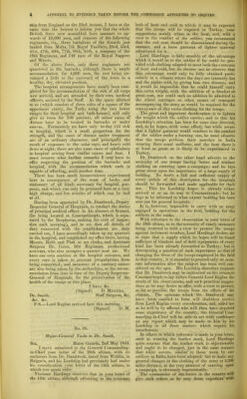
![ship from England on tlic 23rd instant, I have at the same time the honour to inform you that tlie whole British force now assembled here amounts to up- wards of 10,000 men, and consists of the following regiments, viz., three battalions of the Guards just landed from Malta, 7th Eoyal Fusiliers, 23rd, 33rd, 41st, 47th, 49th, 77th, 88th, 95th, a company of the 19th Regiment, and 140 men of the Royal Sappers and Miners. Of the above force, only three regiments are quartered in the barracks, although there is ample accommodation for 4,000 men, the rest being en- camped a little to the eastward of the town in a healthy, dry, elevated position. The hospital arrangements have nearly been com- pleted for tlie accommodation of the sick of all corjis now arrived, and are attended by their own medical officers, assisted by the Statf. As the space allotted to us (which consists of three sides of a square of the uppermost storey, the Turks using the two lower ranges for their hospital and bath-houses) will only give us room for 256 jiatients, all minor cases of disease have to be treated in barracks or under canvas. Fortunately we have only to-day 155 sick in hospital, which is a small proportion for the strength, and the cases of disease under treatment are of an ordinary character, and principally the result of exposure to the solar rays, and heavy cold dews at night; there are also some cases of ophthalmia in hospital arising from similar causes and dust. I must reserve what further remarks I may have to offer respecting the position of the barracks and hospital, with the accommodation which each is capable of alfording, until another time. There has been much inconvenience experienced here in consequence of the want of books and stationary of all kinds necessary for hospital pur- poses, and which can only be procured here at a very hio'h charge, and few articles of which can be had at all. Having been appointed by Dr. Dumbreck, Deputy Inspector General of Hospitals, to conduct the duties of princi25al medical officer in his absence at Scutari, (he being located at Constantinople, which is sepa- rated by the Bosphorus, making his visit of inspec- tion each morning), and to see that all details of duty connected Avith the establishment are duly carried out, I have accordingly taken up my quarters in the hospital, and established my office there, having Messrs. Robb and Pink as my clerks, and Assistant Surgeon Dr. Grier, 92d Regiment, professional assistant, who also occupies a quarter near me. We have our own sentries at the hospital entrance, and every care is taken to prevent irregularities from being committed; and measures of a sanitary nature are also being taken by tlie authorities, at the recom- mendation from time to time of the Deputy Inspector- General of Hospitals, for the preservation of the health of the troops at this place. I have, &c. (Signed) D. Menzies, Dr. Smith, Staff Surgeon, &c. &c. &c. P.S.—Lord Raglan arrived here this morning. (Signed) D. M. No. 16. Major-General Yorke to Dr. Smith. SiK, Horse Guards, 2nd May 1854. I HAVE submitted to the General Commanding- in-Chief your letter of the 28th ultimo, with its enclosure from Dr. Dumbreck, dated from Widdin, in Bulgaria, and his Lordship had previously had under his consideration your letter of the 13th ultimo, to which you again refer. Viscount Hardinge observes that in your letter of the 13th ultimo, although adverting to the extremes both of heat and cold to which it may be expected that the troops will be exposed in Turkey, your suggestions mainly relate to the lieat, and, with a view to the comfort of the soldier, you recommend that the red coat should be discontinued during the summer, and a loose garment of lighter material substituted for it. Lord Hardinge is fully sensible of the advantage which it would be to the soldier if he could he ])ro- vided with clothing adapted to meet both the extremes of heat and cold, but he desires me to observe that this advantage could only be fully obtained parti- cularly in a climate where the days are intensely hot and the nights cold, by giving him two dresses; and it would be impossible that he could himself carry this extra weight, with the addition of a blanket or great coat, nor could such an addition be admitted to tlie wheel carriages or other means of transport accompanying the army as would be required for the conveyance of this extra clothing for the troops. The great and important desideratum is to lighten the weight which the soldier carries; and to this his Lordship's attention has been for some time directed, and, as he hopes, with some effect; but while aware that a lighter garment would conduce to the comfort of the soldier under a burning sun, he must observe that the troops perform their marches in India wearing their usual uniforms, and the heat there is at least as great as is likely to be experienced in Turkey. Dr. Dumbreck on the other hand adverts to the necessity of our troops having better and warmer clothing on entering upon a campaign; and he lays great stress upon the importance of a large supply of bedding. No doubt a full and sufficient supply of every article of this description for the hospitals should be forwarded and made applicable for their use. This his Lordship hopes is already either arrived at or on its way to Constantinople; but he begs to be informed to what extent bedding has been sent out for general hospitals. It is, however, impossible to carry Avith an army engaged in operations in the field, bedding for the soldiers in the ranks. With reference to the observation in your letter of the 28th ultimo, as to the necessity of timely measures being resorted to with a view to protect the troops against inclement weather. Lord Hardinge desires nte to state that a supply which he hopes will be found sufficient of blankets and of lield equipments of every kind has been already forwarded to Turkey; but in determining a question of such importance as that of changing the dress of the Iroops employed in the tield in that country, it is essential to proceed only on accu- rate information after the subject has been well con- sidered on the spot. His Lordship tlierefore requests that Dr. Dumbreck may be instructed on his return to Constantinople to lay before General Lord Raglan the result of his observations, and such jn-actical sugges- tions as he may desire to offer, with a view to protect, as far as possible, the troops from the effects of the climate. The opinions Avhich'Dr. Dumbreck may have been enabled to form will doubtless receive from Lord Raglan every consideration, and, aided too as he will be by officers who will then have acquired some experience of the country, the General Coni- mandnig-in-Chief will be able to act with confidence on any report which may be made to him by his Lordship in all those matters Avhich require his interference. In others to which reference is made in your letter, such as wearing the leather stock. Lord Hardinge quite concurs that the leather stock is objectionable and ought to be changed, just in the same manner that Avhite covers, similar to those Avorn by our soldiers in India, have been adopted; but to make any general changes in the clothing of the army at 3,000 miles distance, at the very moment of entering upon a campaign, is obviously impracticable. The commander of the forces in the country Avill give such orders as he may deem expedient with](https://iiif.wellcomecollection.org/image/b21365210_0766.jp2/full/800%2C/0/default.jpg)