An introduction to the carbon compounds / by R.H. Adie.
- Adie, R. H. (Richard Haliburton)
- Date:
- [1899]
Licence: Public Domain Mark
Credit: An introduction to the carbon compounds / by R.H. Adie. Source: Wellcome Collection.
17/124 page 5
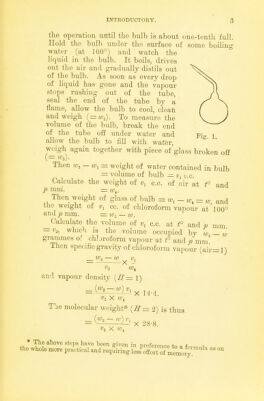
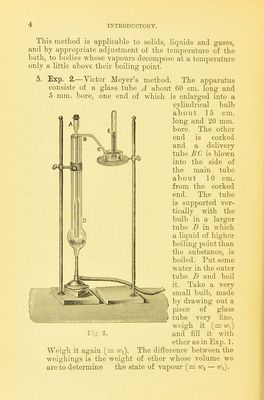
![When bubbles of air have ceased to rise from tlie end of the delivery tube which is immersed in water, place a gas measuring-tube, U, filled with water over the end. Eemove the cork, drop the weighed tube and ether into the bulb, and replace the cork as quickly as possible. In a few moments the ether evaporates and expels air which collects in the gas tube. When the air has been expelled remove the cork, allow the gas tube to cool and read the volume of the gas (yi) and its temperature {t°) and pressiu-e. Correct this volume for temperature, pressure, pres- sure of water vapour at t°, calculate the weight which this corrected volume (=^2) of hydrogen would weigh and divide the weight of ether taken by the weight of the equal volume of hydrogen. Thus vapour density (H = 1) — ^ H loo This method is applicable to solids and liquids which are not easUy decomposable, and can be used with any gas m the bulb, e.g. air, nitrogen, hydrogen, etc. The temperature of the bulb must be some degrees higher than the boilmg pomt of the body whose vapoiu- density is bemg determmed, and water, anihne, oil, sulphur, or fusible alloy are used to heat it. ' i > [Other methods based on the Eaoult method are used in tlie case of bodies which cannot be vaporised without decomposition, but which are soluble. See Tutorial Chemistry, Part II., p. 76 ^^if seq.'] 6. A consideration of the volume changes in the reactions of gases leads to the recognition of the existence of smaUer parts withm the molecules, viz., the atoms, so that molecules are built up of atoms held together by some attractive force which for want of more definite inVrmT tion we call chemical affinity. ri^m-«f°n' ^^'^l^e^^^.^ o^ly contain two atoms, e.g. nfnr. o.f' ^^^f ^^f^ We can only assume that each atom acts on the other, but in the case of other molecules with three or more atoms, e.g. O3 and H,0, we have greater possibilities, as each atom may attrac botl others](https://iiif.wellcomecollection.org/image/b21501269_0017.jp2/full/800%2C/0/default.jpg)
 No text description is available for this image
 No text description is available for this image
 No text description is available for this image