The micro-organism of faulty rum / by V.H. Veley and Lilian J. Veley (née Gould).
- Veley, V. H. (Victor Herbert)
- Date:
- 1898
Licence: Public Domain Mark
Credit: The micro-organism of faulty rum / by V.H. Veley and Lilian J. Veley (née Gould). Source: Wellcome Collection.
16/100 page 4
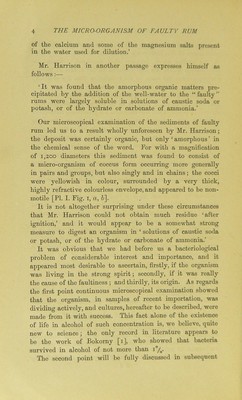
![of the calcium and some of the magnesium salts present in the water used for dilution.’ Mr. Harrison in another passage expresses himself as follows:— ‘It was found that the amorphous organic matters pre- cipitated by the addition of the well-water to the “ faulty ” rums were largely soluble in solutions of caustic soda or potash, or of the hydrate or carbonate of ammonia.’ Our microscopical examination of the sediments of faulty rum led us to a result wholly unforeseen by Mr. Harrison; the deposit was certainly organic, but only ‘ amorphous ’ in the chemical sense of the word. For with a magnification of 1,200 diameters this sediment was found to consist of a micro-organism of coccus form occurring more generally in pairs and groups, but also singly and in chains; the cocci were yellowish in colour, surrounded by a very thick, highly refractive colourless envelope, and appeared to be non- motile [PI. I. Fig. I, a, 6]. It is not altogether surprising under these circumstances that Mr. Harrison could not obtain much residue ‘ after ignition,’ and it would appear to be a somewhat strong measure to digest an organism in ‘ solutions of caustic soda or potash, or of the hydrate or carbonate of ammonia.’ It was obvious that we had before us a bacteriological problem of considerable interest and importance, and it appeared most desirable to ascertain, firstly, if the organism was living in the strong spirit; secondly, if it was really the cause of the faultiness ; and thirdly, its origin. As regards the first point continuous microscopical examination showed that the organism, in samples of recent importation, was dividing actively, and cultures, hereafter to be described, were made from it with success. This fact alone of the existence of life in alcohol of such concentration is, we believe, quite new to science; the only record in literature appears to be the work of Bokorny [i], who showed that bacteria survived in alcohol of not more than i°/0. The second point will be fully discussed in subsequent](https://iiif.wellcomecollection.org/image/b2812697x_0016.jp2/full/800%2C/0/default.jpg)




 No text description is available for this image
 No text description is available for this image
 No text description is available for this image