The micro-organism of faulty rum / by V.H. Veley and Lilian J. Veley (née Gould).
- Veley, V. H. (Victor Herbert)
- Date:
- 1898
Licence: Public Domain Mark
Credit: The micro-organism of faulty rum / by V.H. Veley and Lilian J. Veley (née Gould). Source: Wellcome Collection.
27/100 page 15
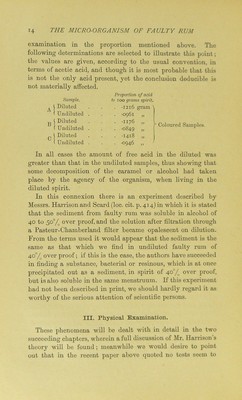
![have been applied for (i) opalescence and (ii) fluorescence ; this would seem to be the more necessary as the authors evidently confuse four totally distinct phenomena, namely, the two just mentioned, (iii) turbidity, and (iv) alteration of refractive index. It may be convenient to remind those of our readers who are interested in the methods of physical science, that the three words turbidity, opalescence, and fluorescence are employed to represent three separate phenomena, each with its special significance and connotation. VVe denote a liquid as turbid when it contains suspended particles which disturb the passage of light through it, rendering it thick without causing any alteration in the character of the light they reflect. Turbidity indicates the presence of particles visible at any rate under the microscope. The term opalescence we have restricted entirely to that phenomenon as originally described by Tyndall, especially with reference to the blue waters of the Alpine lakes and blue sky, which owe their colour to the presence of innumerable particles so fine as to be invisible under the highest magnifica- tion. Light reflected by such particles, when passed through a Nicol’s prism at right angles to the line of incidence, is invariably polarized. Fluorescence consists, as is well-known from the investiga- tions of Sir G. Stokes [3], essentially in the emission by the substance of a light of a different colour from that which falls upon it. Many resins have the property, such for example as a solution of catechu in alcohol, which gives a green fluorescence, and guaiacum, which gives a blue fluorescence. But when such solutions of resins are mixed with water the fluorescence disappears, but opalescence appears. It will be our purpose to demonstrate that the faultiness of rum is properly described primarily as a turbidity, but also as an increased fluorescence, due to the fact that the organism extracts and assimilates that particular ingredient of the caramel, which is fluorescent; dilution of rum with water in no case causes an opalescence.](https://iiif.wellcomecollection.org/image/b2812697x_0027.jp2/full/800%2C/0/default.jpg)
 No text description is available for this image
 No text description is available for this image
 No text description is available for this image