Observations on the chromatology of Actiniae / by C.A. Mac Munn.
- MacMunn, Charles Alexander, 1852-1911.
- Date:
- 1885
Licence: Public Domain Mark
Credit: Observations on the chromatology of Actiniae / by C.A. Mac Munn. Source: Wellcome Collection.
Provider: This material has been provided by The Royal College of Surgeons of England. The original may be consulted at The Royal College of Surgeons of England.
3/30 page 641
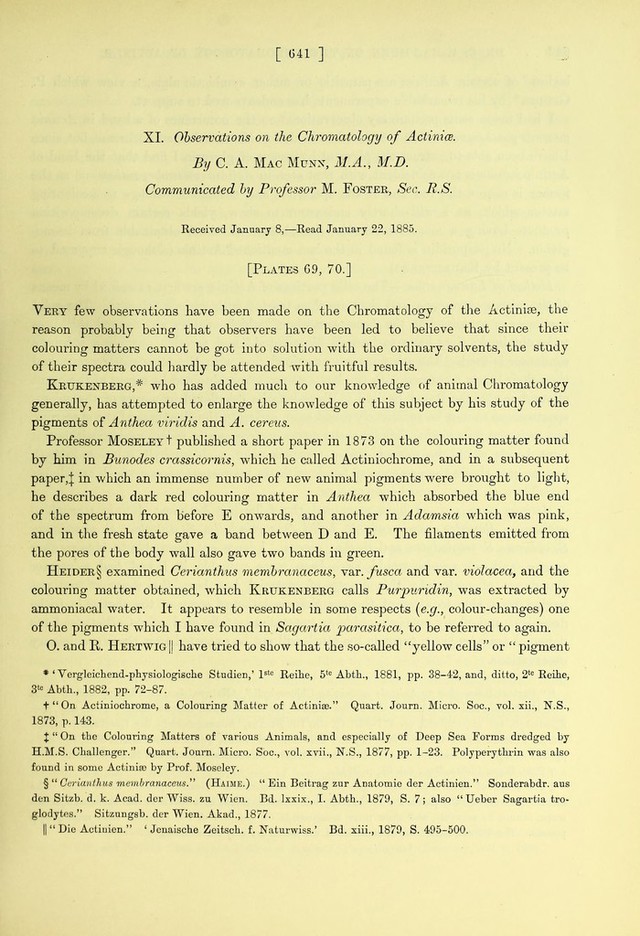
![XI. Observations on the Chromatology of Actinice. By C. A. Mac Munx, M.A., M.D. Communicated by Professor M. Foster, Sec. P.S. Received January 8,—Read January 22, 1885. [Plates G9, 70.] Very few observations have been made on the Chromatology of the Actiniae, the reason probably being that observers have been led to believe that since their colouring matters cannot be got into solution with the ordinary solvents, the study of their spectra could hardly be attended with fruitful results. Krukenberg,# who has added much to our knowledge of animal Chromatology generally, has attempted to enlarge the knowledge of this subject by his study of the pigments of Anthea viridis and A. cereus. Professor Moseley! published a short paper in 1873 on the colouring matter found by him in Bunodes crassicornis, which he called Actiniochrome, and in a subsequent paper,| in which an immense number of new animal pigments were brought to light, he describes a dark red colouring matter in Anthea which absorbed the blue end of the spectrum from before E onwards, and another in Adamsia which was pink, and in the fresh state gave a band between D and E. The filaments emitted from the pores of the body wall also gave two bands in green. Heider§ examined Cerianthus membranaceus, var. fusca and var. violacea, and the colouring matter obtained, which Krukenberg calls Purpuridin, was extracted by ammoniacal water. It appears to resemble in some respects (e.g., colour-changes) one of the pigments which I have found in Sagartia parasitica, to be referred to again. 0. and R. Hertwig|| have tried to show that the so-called “yellow cells” or “ pigment * ‘ Vergleichend-physiologische Studien,’lste Reihe, 5te Abth., 1881, pp. 38-42, and, ditto, 2te Reihe, 3te Abth., 1882, pp. 72-87. t “ On Actiniochrome, a Colouring Matter of Actiniae.” Quart. Journ. Micro. Soc., vol. xii., R.S., 1873, p. 143. { “ On the Colouring Matters of various Animals, and especially of Deep Sea Forms dredged by H.M.S. Challenger.” Quart. Journ. Micro. S'oc., vol. xvii., N.S., 1877, pp. 1-23. Polyperythrin was also found in some Actiniae by Prof. Moseley. § “ Cerianthus membranaceus.” (Haime.) “ Ein Beitrag zur Anatomie der Actinien.” Sonderabdr. aus den Sitzb. d. k. Acad, der Wiss. zu Wien. Bd. lxxix,, I. Abth., 1879, S. 7; also “Ueber Sagartia tro- glodytes.” Sitzungsb. der Wien. Akad., 1877. || “Die Actinien.” 1 Jenaische Zeitsch. f. Naturwiss.’ Bd. xiii., 1879, S. 495-500.](https://iiif.wellcomecollection.org/image/b22289434_0005.jp2/full/800%2C/0/default.jpg)