Diagnostic palpation of the appendix vermiformis : cases of appendicitis / by George M. Edebohls.
- Edebohls, George M. (George Michael), 1853-1908
- Date:
- [1894], ©1894
Licence: Public Domain Mark
Credit: Diagnostic palpation of the appendix vermiformis : cases of appendicitis / by George M. Edebohls. Source: Wellcome Collection.
Provider: This material has been provided by the Augustus C. Long Health Sciences Library at Columbia University and Columbia University Libraries/Information Services, through the Medical Heritage Library. The original may be consulted at the the Augustus C. Long Health Sciences Library at Columbia University and Columbia University.
26/36 (page 20)
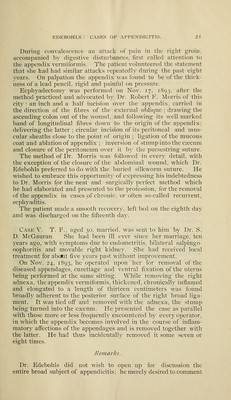
![On examination there were found an endometritis and a right kidney movable to the extent often centimeters. The appendix vermiformis could be palpated as a distinct hard cord, about the diameter of a lead pencil, sensitive on pressure. On Feb. 10, 1893, Dr. Edebohls performed curettage of the uterus, and nephrorrhaphy for fixation of the right kidney. During convalescence from these operations she had an attack of appendicitis, which was treated by blisters and internal medication. She was discharged on March 27, the appendix being still enlarg- ed and sensitive on pressure. The symptoms of appendicitis persisted, with exacerbations, until her readmission a month later. During this time repeated examinations showed the appendix more or less enlarged at various periods. On April 28, he removed the appendix vermiformis by operation. The appendix was found elongated, thickened to the size of a lead pencil, and rigid, representing the so-called chronic catarrhal appendicitis. No packing or drainage, but complete closure of the abdominal wound with buried silkworm sutures. She remained perfectly well until August, when some of the old symptoms returned. An examination showed the left kidney to have become movable to the extent of ten centimeters, the right kidney remaining securely anchored to the lumbar scar. The left kidney, it may be added, was not movable at the time of operation upon the right kidney. He proposed to moor the left kidney by nephrorrhaphy in the near future. [Patient presented.] Case IV. T. L-, 31 years of age, married, mother of two children, was sent to him by Dr. Gerrit Blauvelt, of Nyack, N. Y. She considered herself fairfy well up to the date of the birth of her first child, ten years ago. Since then she has suffered much from backaches, headache, leucorrhcea, nervousness and dyspepsia. Following the birth of her second child, four years ago, all the above symptons became aggravated, menorrhagia and bearing down sensations in the pelvis being superadded. In February, 1893, she was operated upon by a distinguished surgeon of this city, who performed trachelorrhaphy and shorten- ing of the round ligaments at one sitting. Although the anatomical results attained by the operations were perfect, no therapeutical results followed, the patient remaining the same as before the operation. In August, 1893, by the advice of her family physician, she consulted Dr. Edebohls. Examination showed the uterus in normal anteversion, the cervix well repaired and a trifle conical, endometritis, bilateral catarrhal salpingitis of a mild type, and a right kidney movable to the extent of five centimeters. The movable right kidney being held responsible for most of her symptoms, nephrorrhaphy was advised and performed on Oct. 20, 1893, curettage of the uterus being clone at the same sitting.](https://iiif.wellcomecollection.org/image/b21223580_0026.jp2/full/800%2C/0/default.jpg)