The theory and practice of infant feeding with notes on development.
- Chapin, Henry Dwight, 1857-1942.
- Date:
- 1902
Licence: Public Domain Mark
Credit: The theory and practice of infant feeding with notes on development. Source: Wellcome Collection.
Provider: This material has been provided by the Harvey Cushing/John Hay Whitney Medical Library at Yale University, through the Medical Heritage Library. The original may be consulted at the Harvey Cushing/John Hay Whitney Medical Library at Yale University.
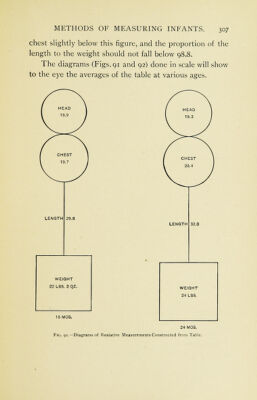
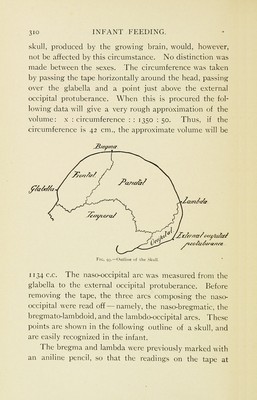
330/348 page 312
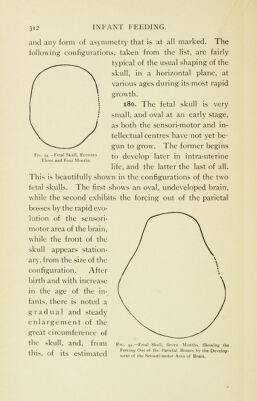
![Fig. 94.—Fetal Skull, Between Three and Four Months. and any form of asymmetry that is at all marked. The following configurations, taken from the list, are fairly typical of the usual shaping of the skull, in a horizontal plane, at various ages during its most rapid growth. 180. The fetal skull is very small, and oval at an early stage, as both the sensori-motor and in- tellectual centres have not yet be- gun to grow. The former begins to develop later in intra-uterine life, and the latter the last of all. This is beautifully shown in the configurations of the two fetal skulls. The first shows an oval, undeveloped brain, while the second exhibits the forcing out of the parietal bosses by the rapid evo- lution of the sensori- motor area of the brain, while the front of the skull appears station- ary, from the size of the configuration. After birth and with increase iii the age of the in- fants, there is noted a gradual and steady enlargement of the great circumference of the Skull, and, frOlT) FIG, 95.-Fetal Skull, Seven Months, Showing the 1] ■ r •■ ,• , . Forcing Out of the Parietal Bosses by the Develop- UllS, OI US estimated ment of the Sensori-motor Area of Brain.](https://iiif.wellcomecollection.org/image/b21030601_0330.jp2/full/800%2C/0/default.jpg)