The vocabulary of philosophy, mental, moral, and metaphysical : with quotations and references for the use of students / by William Fleming ; edited by Henry Calderwood.
- Date:
- 1876
Licence: Public Domain Mark
Credit: The vocabulary of philosophy, mental, moral, and metaphysical : with quotations and references for the use of students / by William Fleming ; edited by Henry Calderwood. Source: Wellcome Collection.
Provider: This material has been provided by the Royal College of Physicians of Edinburgh. The original may be consulted at the Royal College of Physicians of Edinburgh.
23/590
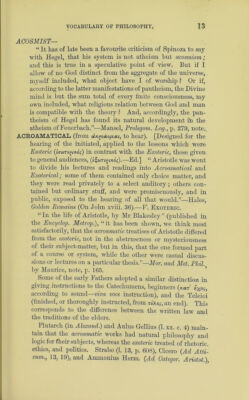
![ACOSMIST— “ It lias of late been a favourite criticism of Spinoza to say with Hegel, that his system is not atheism but acosmism; and this is true in a speculative point of view. But if I allow of no God distinct from the aggregate of the universe, myself included, what object have I of worship ? Or if, according to the latter manifestations of pantheism, the Divine mind is but the sum total of every finite consciousness, my own included, what religious relation between God and man is compatible with the theory ? And, accordingly, the pan- theism of Hegel has found its natural development in the atheism of Feuerbach.”—Mansel, Prolegom. Log., p. 279, note. ACROAMATICAL (from ctx,(>oa.o/ucii, to hear). [Designed for the hearing of the initiated, applied to the lessons which were Esoteric (barepx.6;) in contrast with the Exoteric, those given to general audiences, (e$aregi>t6;).—Ed.] “ Aristotle was wont to divide his lectures and readings into Acroamatical and Exoterical; some of them contained only choice matter, and they were read privately to a select auditory; others con- tained but ordinary stuff, and were promiscuously, and in public, exposed to the hearing of all that would.”—Hales, Golden Remains (On John xviii. 36).— V. Exoteric. “ In the life of Aristotle, by Mr Blakesley ” (published in the Encyclop. Metrop.), “it has been shown, we think most satisfactorily, that the acroamatic treatises of Aristotle differed from the exoteric, not in the abstruseness or mysteriousness of their subject-matter, but in this, that the one formed part of a course or system, while the other were casual discus- sions or lectures on a particular thesis.”—Mor. and Met. Phil. by Maurice, note, p. 165. Some of the early Fathers adopted a similar distinction in giving instructions to the Catechumens, beginners (kut f,Xcc, according to sound—viva voce instruction), and the Teleioi (finished, or thoroughly instructed, from tsAoj, an end). This corresponds to the difference between the written law and the traditions of the elders. Plutarch (in Alexand.) and Aulus Gellius (1. xx. c. 4) main- tain that the acroamatic works had natural philosophy and logic for their subjects, whereas the exoteric treated of rhetoric, ethics, and politics. Strabo (1. 13, p. 608), Cicero {Ad Atti- curm, 13, 19), and Ammonius Herm. (Ad Categor. Aristot.),](https://iiif.wellcomecollection.org/image/b2199531x_0023.jp2/full/800%2C/0/default.jpg)