The vocabulary of philosophy, mental, moral, and metaphysical : with quotations and references for the use of students / by William Fleming ; edited by Henry Calderwood.
- Date:
- 1876
Licence: Public Domain Mark
Credit: The vocabulary of philosophy, mental, moral, and metaphysical : with quotations and references for the use of students / by William Fleming ; edited by Henry Calderwood. Source: Wellcome Collection.
Provider: This material has been provided by the Royal College of Physicians of Edinburgh. The original may be consulted at the Royal College of Physicians of Edinburgh.
24/590
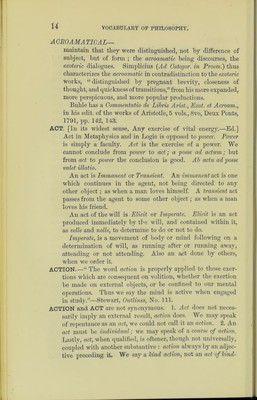
![ACROAMATICAL— maintain that they were distinguished, not hy difference of subject, but of form ; the acroamatic being discourses, the exoteric dialogues. Simplicius (Ad Categor. in Proem.) thus characterizes the acroamatic in contradistinction to the exoteric works, “ distinguished by pregnant brevity, closeness of thought, and quickness of transitions,” from his more expanded, more perspicuous, and more popular productions. Buhle has a Commentatio de Libris Arist., Exot. et Acroam., in his edit, of the works of Aristotle, 5 vols., 8vo, Deux Ponts, 1791, pp. 142, 143. ACT. [In its widest sense, Any exercise of vital energy.—Eel.] Act in Metaphysics and in Logic is opposed to power. Poiver is simply a faculty. Act is the exercise of a power. We cannot conclude from power to act; a posse ad actum; but from act to poiver the conclusion is good. Ah actu ad posse valet illatio. An act is Immanent or Transient. An immanent act is one which continues in the agent, not being directed to any other object; as when a man loves himself. A transient act passes from the agent to some other object; as when a man loves his friend. An act of the will is Elicit or Imperate. Elicit is an act produced immediately by the will, and contained within it, as velle and nolle, to determine to do or not to do. Imperate, is a movement of body or mind following on a determination of will, as running after or running away, attending or not attending. Also an a£t done by others, when we order it. ACTION.—“ The word action is properly applied to those exer- tions which are consequent on volition, whether the exertion be made on external objects, or be confined to our mental operations. Thus we say the mind is active when engaged in study.”—Stewart, Outlines, No. 111. ACTION and ACT are not synonymous. 1. Act does not neces- sarily imply an external result, action does. We may speak of repentance as an act, we could not call it an action. 2. An act must be individual; we may speak of a course of action. Lastly, act, when qualified, is oftener, though not universally, coupled with another substantive : action always by an adjec- tive preceding it. We say a hind action, not an act of hind-](https://iiif.wellcomecollection.org/image/b2199531x_0024.jp2/full/800%2C/0/default.jpg)