The vocabulary of philosophy, mental, moral, and metaphysical : with quotations and references for the use of students / by William Fleming ; edited by Henry Calderwood.
- Date:
- 1876
Licence: Public Domain Mark
Credit: The vocabulary of philosophy, mental, moral, and metaphysical : with quotations and references for the use of students / by William Fleming ; edited by Henry Calderwood. Source: Wellcome Collection.
Provider: This material has been provided by the Royal College of Physicians of Edinburgh. The original may be consulted at the Royal College of Physicians of Edinburgh.
38/590
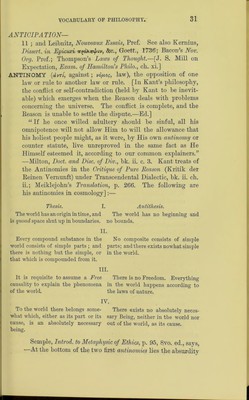
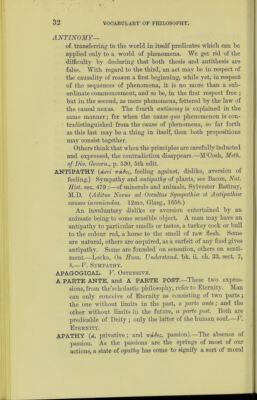
![AN IMA MTJNDI— waters still gives life to all nature.—Buddeus, Klein. Phil., pars 3, cap. 6, sec. 11, 12, et seq. The doctrine of the anima mundi, as held by the Stoics and Stratonicians, is closely allied to pantheism; while according to others this soul of the universe is altogether intermediate between the Creator and His works. See Plato, Timceus, 29 D.—30 c; Bonitz, De alliance mun- dance apud Platonem dementis, 8vo, Lips., 1837; Schelling, De I'Ame de Monde, 8vo, Hamb., 1809. [ANIMISM.—A doctrine of soul as distinct from body, and separated from it at death. For the extent to which such a doctrine is believed among uncivilized tribes, v. Tyler’s Primitive Culture.—Ed.] ANTECEDENT (antecedo, to go before).—“ And the antecedent shall you fynde as true when you rede over my letter as himself can not say nay, but that the consecusyon is formal.”—Sir T. More’s Works, p. 1115. In a relation, whether logical or metaphysical, the first term is the antecedent, the second the consequent. Thus in the relation of causality—the cause is the antecedent, and the effect the consequent. In Grammar, the antecedent is that to which the relative refers. In Logic, antecedent is the former of two propositions, in a species of reasoning, which, without the intervention of any middle proposition, leads directly to a fair conclusion; and this conclusion is termed the consequent. Thus, I reflect, therefore I exist. I reflect, is the antecedent—therefore I exist, is the consequent.—Euler, Letters to a German Princess. —V. Proposition Hypothetical. Antecedent is that part of a conditional proposition on which the other depends.”—Whately, Log., bk. ii. ch. 4, sec. 6. ANTHROPOLOGY (aiand Aoyo?, the science of man).— Among naturalists it means the natural history of the human species. According to Hr. Latham (Nat. Hist, of Varieties of Man, Lond., 1830), anthropology determines the relations of man to the other mammalia; ethnology, the re- lations of the different varieties of mankind to each other, p. 559. Otto Casmann, about 1596, gave the name Anthropologia to the science of man in general, which he divided into two parts_the first Psychologia, the doctrine of the human mind;](https://iiif.wellcomecollection.org/image/b2199531x_0038.jp2/full/800%2C/0/default.jpg)