The vocabulary of philosophy, mental, moral, and metaphysical : with quotations and references for the use of students / by William Fleming ; edited by Henry Calderwood.
- Date:
- 1876
Licence: Public Domain Mark
Credit: The vocabulary of philosophy, mental, moral, and metaphysical : with quotations and references for the use of students / by William Fleming ; edited by Henry Calderwood. Source: Wellcome Collection.
Provider: This material has been provided by the Royal College of Physicians of Edinburgh. The original may be consulted at the Royal College of Physicians of Edinburgh.
39/590
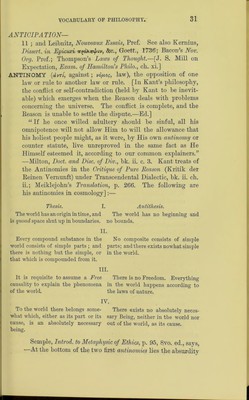
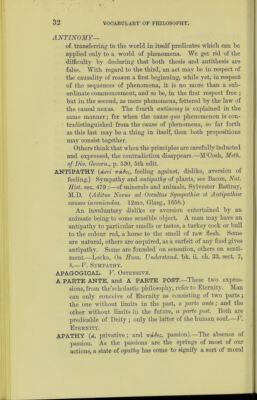
![ANTHROPOLOGY— the second Sematologia, the doctrine of the human body; and these still continue to be the usual appellations of these branches of knowledge Tn Germany.—Sir W. Hamilton, Led. I. p. 136. The German philosophers since the time of Kant have used it to designate all the sciences which in any point of view relate to man—soul and body—individual and species—facts of history and phenomena of consciousness— rides of morality as well as interests material, and changing; so that works under the general title of anthropology treat of very different topics. “ Anthropology is the science of man in all his natural variations. It deals with the mental peculiarities which belong specifically to different races, ages, sexes, and tempera- ments, together with the results which follow immediately from them in their application to human life.”—Morell, Psychology, p. 1. In an anonymous work entitled Anthropologie Abstracted, 8vo, Lond., 1655, Anthropology is divided into Psychology and Anatomy. ANTHROPOMORPHISM (chi6ou7roc, man; form).— [A theory which represents Divine attributes as only human , attributes enlarged. In modern times, the name has been restricted to theories which attribute the characteristics of the human mind to the Divine mind.—Ed.] “ It was the opinion of the Anthropomcrphites that God had all the parts of a man, and that we are, in this sense, made according to his image.”—More, Def. of Cabbala, c. 1. Melito, of Sardis, was the first Christian writer who ascribed body to Deity. The ascribing of bodily parts or members to Deity is too gross a delusion to call for refutation. It is wittily exposed by Cicero, Be Nat. Deor., lib. i. cap. 27. But there is a spiritual anthropomorphism, sometimes also called anthropopathy, which ascribes to him the acts, passions, senti- ments, and proceedings of human nature. “We ought not to imagine that God is clothed with a human body, as the Antliropomorphites asserted, under colour that that figure was the most perfect of any.”— Malebranche, Search after Truth, bk. iii. ch. 9. Hume applies the name to those who think the mind of God is like the mind of man.—Dial, on Nat. Relig., parts iv., v.](https://iiif.wellcomecollection.org/image/b2199531x_0039.jp2/full/800%2C/0/default.jpg)