The vocabulary of philosophy, mental, moral, and metaphysical : with quotations and references for the use of students / by William Fleming ; edited by Henry Calderwood.
- Date:
- 1876
Licence: Public Domain Mark
Credit: The vocabulary of philosophy, mental, moral, and metaphysical : with quotations and references for the use of students / by William Fleming ; edited by Henry Calderwood. Source: Wellcome Collection.
Provider: This material has been provided by the Royal College of Physicians of Edinburgh. The original may be consulted at the Royal College of Physicians of Edinburgh.
503/590
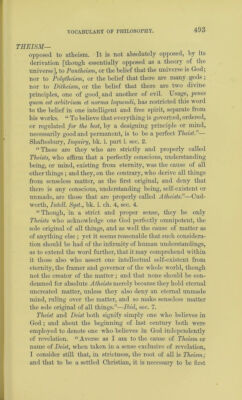
![THEISM— opposed to atheism. It is not absolutely opposed, by its derivation [though essentially opposed as a theory of the universe], to Pantheism, or the belief that the universe is God; nor to Polytheism, or the belief that there are many gods ; nor to Ditheism, or the belief that there are two divine principles, one of good^and another of evil. Usage, 'penes quern est arbitrium et norma loquendi, has restricted this word to the belief in one intelligent and free spirit, separate from his works. “ To believe that everything is governed, ordered, or regulated for the best, by a designing principle or mind, necessarily good and permanent, is to be a perfect Theist.”— Shaftesbury, Inquiry, bk. i. part i. sec. 2. “These are they who are strictly and properly called Theists, who affirm that a perfectly conscious, understanding being, or mind, existing from eternity, was the cause of all other things ; and they, on the contrary, who derive all things from senseless matter, as the first original, and deny that there is any conscious, understanding being, self-existent or unmade, are those that are properly called Atheists.”—Cud- worth, Intell. Syst., bk. i. ch. 4, sec. 4. “Though, in a strict and proper sense, they be only Theists who acknowledge one God perfectly omnipotent, the sole original of all things, and as well the cause of matter as of anything else ; yet it seems reasonable that such considera- tion should be had of the infirmity of human understandings, as to extend the word further, that it may comprehend within it those also who assert one intellectual self-existent from eternity, the framer and governor of the whole world, though not the creator of the matter ; and that none should be con- demned for absolute A theists merely because they hold eternal uncreated matter, unless they also deny an eternal unmade mind, ruling over the matter, and so make senseless matter the sole original of all things.”-—Ibid, sec. 7. Theist and Deist both signify simply one who believes in God ; and about the beginning of last century both were employed to denote one who believes in God independently of revelation. “ Averse as I am to the cause of Theism or name of Deist, when taken in a sense exclusive of revelation, I consider still that, in strictness, the root of all is Theism; and that to be a settled Christian, it is necessary to be first](https://iiif.wellcomecollection.org/image/b2199531x_0503.jp2/full/800%2C/0/default.jpg)