Licence: In copyright
Credit: The prevention of destitution / by Sidney and Beatrice Webb. Source: Wellcome Collection.
Provider: This material has been provided by London School of Hygiene & Tropical Medicine Library & Archives Service. The original may be consulted at London School of Hygiene & Tropical Medicine Library & Archives Service.
28/384 page 14
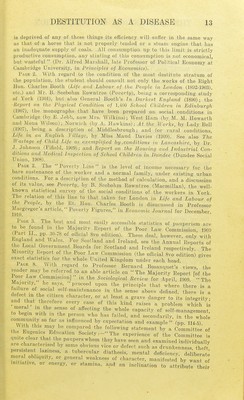
![misfortune to their own too great generosity or too great goodness, and generally to bad luck (Eugenics Review, Vol. IT., No. 3, pp. 187-8). It would scarcely be inferred from this statement that one-third of all the £aupers are sick, one-third children, and one-ciuarteFT either wiaPTys encumbered by young families, or certified lunatics! TheaauTE, aT51e- 'bodied, lieaKhy men, to whom alone the statement applies, number fewer than 2 per cent, of the total. The 98 per cent, are left out of sight! The whole argument of Professor Bosanquet, and of the school of thought which he represents, is subjected to analysis in The Minority Report for Scotland, which has been separately published by the Scottish National Committee for the Prevention of Destitution, 180, Hope Street, Glasgow (price 6d.). Page 8. The views of Professor E. T. Devine, of the New York Charity Organisation Society, will be found in his Misery and its Causes (Mac- millan : 1909), a remarkable book in which the outcome of the experience of the New York C.O.S. is presented, with many illustrative cases. Professor Devine uses the word misery (the French la mis'ere) to signify what we term destitution. The question that I raise, he states, is whether the wretched poor, the poor who suffer in their poverty, are poor because they are shiftless, because they are undisciplined, because they drink, because they steal, because they have superfluous children, because of personal depravity, personal inclination, and natural preference; or whether they are shiftless and undisciplined and drink and steal and are unable to care for their too numerous children because our social institu- tions and economic arrangements are at fault. I hold that personal depravity is as foreign to any sound theory of the hardships of our modern poor as witchcraft or demoniacal possession; that these hardships are economic, social, transitional, measurable, manageable. Misery [destitution], as we say of tuberculosis, is communicable, curable, and preventable. It lies not in the unalterable nature of things, but in our particular human institutions, our social arrangements, our tenements and streets and sub- ways, our laws and courts and jails, our religion, our education, our philanthropy, our politics, our industry, and our business (p. 11). Page 11. Besides the Minority Report of the Poor Law Commission (popular edition, 2 vols., 2s.; Index, Is.), and the works already cited, the reader may be referred to the threepenny pamphlet, entitled Destitution : can we end it? by the Rev. Henry Carter (Wesleyan Methodist '^nion for Social Service; J. J. Stark, Ashmead, Orleans Road, Upper Norwood, S.E ), which affords a convenient summary of the present situation, aud of the proposals of the Minority Report, with references to statistical and other authorities. \ 1](https://iiif.wellcomecollection.org/image/b21361149_0028.jp2/full/800%2C/0/default.jpg)