Diseases of women, including their pathology, causation, symptoms, diagnosis and treatment : a manual for students and practitioners / by Arthur W. Edis.
- Edis, Arthur W. (Arthur Wellesley), 1840-1893.
- Date:
- 1881
Licence: Public Domain Mark
Credit: Diseases of women, including their pathology, causation, symptoms, diagnosis and treatment : a manual for students and practitioners / by Arthur W. Edis. Source: Wellcome Collection.
100/566 (page 80)
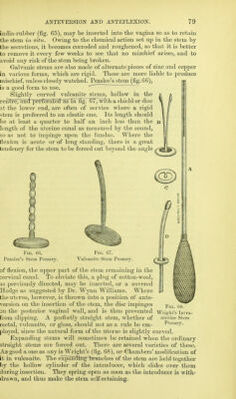
![The disadvantage is that the diverging points tend to press on the interior of the sides of the uterus, and so set up irritation, more especially as the weight of the fundus is sustained on the two pro- jecting points. Other expanding stems, consisting of a hollow stem with divei'ging bi'anches, are also employed. The great disadvantage of nearly all these is, that the diameter of the stem is too large for the majority of the cases in which their employment is necessitated. In all cases where evidence of inflammatory mischief exists, this must be first remedied before thinking of resorting to any mechanical treatment. The application of a few leeches, puncture with the scarifier-, injections of hot water into the vagina, the application of plugs of cotton-wool morning and evening, saturated with glycerine or with glycerine and iodine, rest in bed for a few days, saline aperi- ents, and othei' appro]:)riate remedies, must first be tried. The sound may then be passed, in order to ascertain whether the uter us will tolerate interference. If no severe pain or constitutional disturbance ensue, the same measures may cautiously be adojjted as previously de- ,' scribed. Commencing with the mer'e passage of the sound, we may . gradually proceed to restoring the position of the fundus, dilating the [ canal by graduated bougies or a laminaria tent, inserting an elastic, i expanding, or vulcanite stem ; watching carefully lest any symptoms * of mischief arise, desisting from further treatment the moment ther-e 1 is any evidence of intolerance of it. Where there is a marked history of previous gonorrbceal infection, pelvic peritonitis, or cellulitis, we should, as a rule, avoid resorting to mechanical interference. After the introduction of an intr'a-uterine stem, it is better to keep the patient in bed for the first few days, and see her daily. If any febrile symptoms occur the stem should at once be withdrawn. When these have subsided the stem may again be passed, but the patient must be carefrrlly watched. She should always be either within reach, or be able to withdraw the stem by a string attached to it. It should, as a rule, be removed during the period of menstruation, irntil we have ascertained that the uterus tolerates its presence without in- Hammatory mischief ensuing, when it may be allowed to remain in dur ing the periods. In the case of married patients it is well to avoid all risks by enjoining abstinence for a time at least, as well as pro- hibiting all unnecessary exertion of any kind. There is always a certain amouiit of congestion, with increased secretion, as long as the Stem is worn. On its removal, however, this soon subsides, and a I process analogous to irrvolution takes place. Impregnation not in- frequently occurs within a few months. Even after par-turition there i is a great tendency for the flexion to recur, which may need treatment ', befor'e impregnation again takes place. Flexions are generally of i gradual production, not sudden, as is the case often with versions, so ' that we must be prepared to allow many mouths to elapse before ex- pecting to straighten the irterine axis by means of a stem. In those cases wher-e difliculty is experienced in retainirrg a stem in situ, it may be necessary to resort to a combined intra-uterine stem and a vaginal support, but they should never be made in one piece, otherwise the mobility of the uterus is seriously interfered with, and the patient is exposed to danger from shocks. Still cases will be met](https://iiif.wellcomecollection.org/image/b20394676_0100.jp2/full/800%2C/0/default.jpg)