Diseases of women, including their pathology, causation, symptoms, diagnosis and treatment : a manual for students and practitioners / by Arthur W. Edis.
- Edis, Arthur W. (Arthur Wellesley), 1840-1893.
- Date:
- 1881
Licence: Public Domain Mark
Credit: Diseases of women, including their pathology, causation, symptoms, diagnosis and treatment : a manual for students and practitioners / by Arthur W. Edis. Source: Wellcome Collection.
76/566 (page 56)
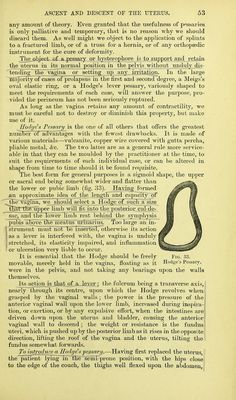
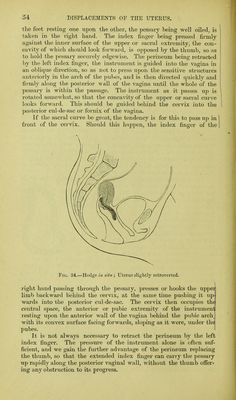
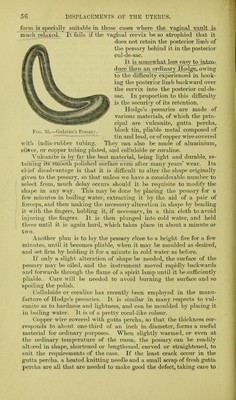
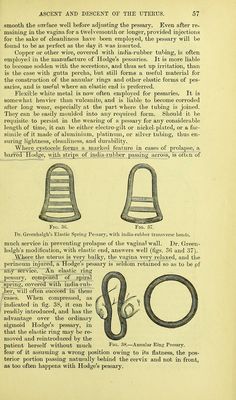
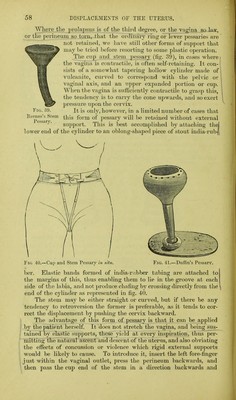
![form is specially suitable in those cases where the vaginal vault is much relaxed. It fails if the vaginal cervix be so atrophied that it does not retain the posterior liml) of the pessary behind it in the posterior cul-de-sac. It is somewhat less easy to intro- duce than an ordinary Hodge, owing to the difficulty experienced in hook- ing the posterior limb backward over the cervix into the posterior cul-de- sac. In propor tion to this difficulty is the security of its retention. Hodge's pessaries are made of various materials, of which the prin- cipal are vulcanite, gutta percha, Fig. .85.—Gal.iliiii's Pessarv. block tin, pliable metal composed of tin and lead, or of copper wire covered with india-i-ubber tubing. They can also be made of aluminium, silcer, or copper tirbing pLited, and celluloide or coraline. Vulcanite is hj far the best material, being light and durable, re- taining its smooth polished surface even after mariy years' wear. Its cbief disadvantage is that it is difficult to alter the shape originally given to the pessary, so that vruless we have a considerable number to select from, much delay occurs should it be requisite to modify the shape in any way. This may be done by placing the pessary for a few minutes in boiling water, extracting it by the aid of a pair of forceps, and then making the necessary alteration in shape by bending it with the fingers, holding it, if necessary, in a thin cloth to avoid injuring the fingers. It is then plunged into cold water, and held there until it is again hard, which takes place in about a minute or two. Ariother plan is to lay the pessary close to a bright fire for a few minutes, uritil it becomes pliable, when it may be moulded as desii-ed, and set fir m by holding it for a minute in cold water as before. If only a slight alteration of shape be needed, the surface of the pessary may be oiled, and the instrument moved rapidly backwards and forwards thr'ough the flame of a spirit lamp until it be sufficiently pliable. Care will be needed to avoid burning the surface and so spoiling the polish. C'elhrloide or; coraline has recently been employed in the mann- factirre of Hodge's pessaries. It is similar in many respects to vul- canite as to har'dness and lightness, and can be moulded by placing it in boiling water. It is of a pretty coral-like colour. Copper wire covei'ed with gvrtta percha, so that the thickness cor- re.sponds to about one-third of an inch in diameter, forms a useful material for ordinary ])urposes. When slightly warmed, or even at the ordinary temper-ature of the r'oom, the pessary can be readily alt'^r-ed in shape, shortened or lengthened,'curwed or straightened, to suit the recjuii-ements of the case. If the least crack occur in the gutta percha, a heated knitting needle and a small scrap of fresh gutta percha are all that are needed to make good the defect, taking care to](https://iiif.wellcomecollection.org/image/b20394676_0076.jp2/full/800%2C/0/default.jpg)