Diseases of women, including their pathology, causation, symptoms, diagnosis and treatment : a manual for students and practitioners / by Arthur W. Edis.
- Edis, Arthur W. (Arthur Wellesley), 1840-1893.
- Date:
- 1881
Licence: Public Domain Mark
Credit: Diseases of women, including their pathology, causation, symptoms, diagnosis and treatment : a manual for students and practitioners / by Arthur W. Edis. Source: Wellcome Collection.
96/566 (page 76)
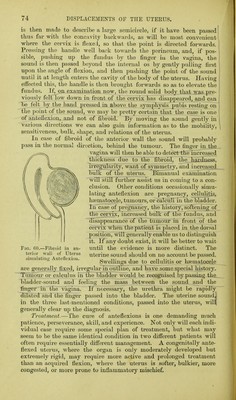
![within a week of the expected return of the catamenia. Should the pain usually experienced at this period be much lessened, the occa- , sional passage of the sound about once a week, for a short time, \ although it will not cure the anteflexion, will often prove sufficient I to relieve urgent symptoms. If it be deemed expedient to attempt ] moie, we may proceed to dilate the cervical canal by means of gra- duated bougies, increasing the size each time, until a No. 10 or 12 ~- will pass readily. This will have the eifect of stimulating the develop- ment of the uterus, at the same time overcoming the constriction at the intei-nal os. Chalybeate tonics, such as the citi-ate of quinine and iron with strychnia; a pill containing phosphorus, iron, and nux vomica, or other suitable form; should at the same time be given, so as to improve the tone of the genei'al health. Another method of accomplishing the same object is, by inserting a small laminaria tent within the canal of the uterus, and allowing it to remain in for eight or ten hours. This produces softening of the wall of the uterus, straightens out the flexion, and stimulates the development of the uterus. It is, however, not unattended by risk, and should never be resorted to until we have previously ascertained whether the ixterus is tolerant of interference. The safest time to I attempt it is a week or so after the menstrual period. The better ' plan is to pass the tent between the hours of 9 and 11a.m., the patient remaining in bed. The tent should then be withdrawn between 6 and 9 p.m. A morphia suppository may be employed if much nausea or pain be produced. The following day the patient should be confined to the couch until the uterus has had time to con- tract again. She should keep lying on the back, and allow the bladder to I'emain distendeil as much as possible. If no inconvenience arise, the patient may resume her ordinary duties after this. The same process may be repeated again in ten days' or a fortnight's time. It is not a prudent plan to inseit a tent whilst in the consulting-room, and then allow the patient to return home. It should invariably be ■ done at her residence when she is in bed. In single women thedysmenoi-rhnea, irritability of the bladder, and other symptoms are often thereby much improved, and in the case of married women, impregnation not infrequently takes place. Galabin's, Thomas's, Hewitt's, or other appropriate form of Anteversion Pessary may be inserted into the vagina with a view of supplementing the other measui-es adopted for straightening out the viterus, but as a rule they only tend to cause the utei'us to revolve \xpon its axis of suspension, and do not succeed in straightening out the flexion. It is difficult to exert any power upon the displaced fundus, and theie are no natural forces called into play tending to accomplish this object, as in the case of retroflexion. A Hodge's pessary is here as a rule of little avail, since the upper limb naturally inclines to the posterior cul-de-sac of the vagina. In some instances, in virgins, where the vaginal canal is small, it is pos- sible to adjust a Hodge so that the upper limb rests on the antei-ior cul-de-sac, the fundus resting upon the end, the cervix passing through i the instrument, the lower limb lying parallel with the posterior wall }](https://iiif.wellcomecollection.org/image/b20394676_0096.jp2/full/800%2C/0/default.jpg)