A first study of the statistics of insanity and the inheritance of the insane diathesis / by David Heron.
- Heron, David
- Date:
- 1907
Licence: In copyright
Credit: A first study of the statistics of insanity and the inheritance of the insane diathesis / by David Heron. Source: Wellcome Collection.
Provider: This material has been provided by King’s College London. The original may be consulted at King’s College London.
31/40 page 29
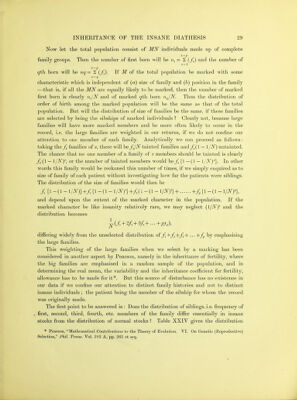
![Now let the total population consist of MN individuals made up of complete family groups. Then the number of first born will he n^= S {fg) and the number of s = l qih. born will be nq= 2 (jC)- If ^ of the total population be marked with some s = q characteristic which is independent of (a) size of family and [h] position in the family —that is, if all the MN are equally likely to be marked, then the number of marked first born is clearly nJN and of marked ^th born n^jN. Thus the distribution of order of birth among the marked population will be the same as that of the total population. But will the distribution of size of families be the same, if these families are selected by being the sibships of marked individuals ? Clearly not, because large families will have more marked members and be more often likely to occur in the record, i.e. the large families are weighted in our returns, if we do not confine our attention to one member of each family. Analytically we can proceed as follows : taking the fg families of s, there will bey^/iV tainted families andy^(l — 1/-^) untainted. The chance that no one member of a family of s members should be tainted is clearly — ijNy, or the number of tainted members would be— (1 — l/iV)*}. In other words this family would be reckoned this number of times, if we simply enquired as to size of family of each patient without investigating how far the patients were siblings. The distribution of the size of families would then be / {1 - (1 - +/, {1 - (1 - iim^ +y; (1 - (1 - iiNY)+ +/. {1 - (1 - mn and depend upon the extent of the marked character in the population. If the marked character be like insanity relatively rare, we may neglect {ijNf and the distribution becomes differing widely from the unselected distribution of -^-/^+ ••• by emphasising the large families. This weighting of the large families when we select by a marking has been considered in another aspect by Pearson, namely in the inheritance of fertility, where the big families are emphasised in a random sample of the population, and in determining the real mean, the variability and the inheritance coefiicient for fertility, allowance has to be made for it*. But this source of disturbance has no existence in our data if we confine our attention to distinct family histories and not to distinct insane individuals ; the patient being the member of the sibship for whom the record was originally made. The first point to be answered is : Does the distribution of siblings, i.e. frequency of . first, second, third, fourth, etc. members of the family differ essentially in insane stocks from the distribution of normal stocks ? Table XXIV gives the distribution * Pearson, Mathematical Contributions to the Theory of Evolution. VI. On Genetic (Reproductive) Selection, Fhil. Trans. Vol. 192 A, pp. 261 et seq.](https://iiif.wellcomecollection.org/image/b21295608_0031.jp2/full/800%2C/0/default.jpg)