The human brain: its structure, physiology and diseases. With a description of the typical forms of brain in the animal kingdom / [Samuel Solly].
- Samuel Solly
- Date:
- 1847
Licence: Public Domain Mark
Credit: The human brain: its structure, physiology and diseases. With a description of the typical forms of brain in the animal kingdom / [Samuel Solly]. Source: Wellcome Collection.
145/720 (page 117)
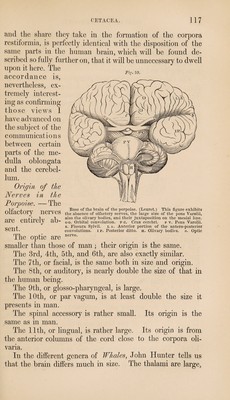
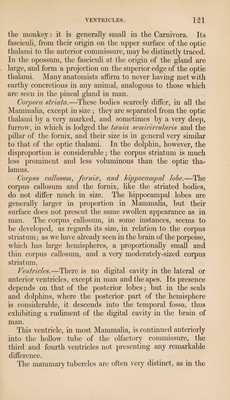
![Fir. 59. and the share they take in the formation of the corpora restiformia, is perfectly identical with the disposition of the same parts in the human brain, which will be found de¬ scribed so fully further on, that it will be unnecessary to dwell upon it here. The accordance is, nevertheless, ex¬ tremely interest¬ ing as confirming those views 1 have advanced on the subject of the c ommunicat ions between certain parts of the me¬ dulla oblongata and the cerebel¬ lum. Origin of the Nerves in the Porpoise. —The nl+ArTninr tipwpq Base of the brain of the porpoise. (Leuret.) This figure exhibits OUdOlOiy liei VOS the absence of olfactory nerves, the large size of the pons Varolii, I* ] P also the olivary bodies, and their juxtaposition on the mesial line. cllC eilllieiy do- 00. Orbital convolution, pc. Crus cerebri. p v. Pons Varolii. x s. Fissura Sylvii. la. Anterior portion of the antero-posterior SeilL. convolutions, ip. Posterior ditto, h. Olivary bodies, o. Optic The optic are nerve' smaller than those of man ; their origin is the same. The 3rd, 4th, 5th, and 6th, are also exactly similar. The 7th, or facial, is the same both in size and origin. The 8th, or auditory, is nearly double the size of that in the human being. The 9th, or glosso-pharyngeal, is large. The 10th, or par vagum, is at least double the size it presents in man. The spinal accessory is rather small. Its origin is the same as m man. rp The 11th, or lingual, is rather large. Its origin is from the anterior columns of the cord close to the corpora oli- varia. In the different genera of Whales, John Hunter tells us that the brain differs much in size. The thalami are large,](https://iiif.wellcomecollection.org/image/b29302717_0145.jp2/full/800%2C/0/default.jpg)