An inquiry into the physiological mechanism of respiration : with especial reference to the movements of the vertebral column and diaphragm / by J.F. Halls Dally.
- Dally, John Frederick Halls, 1877-1944.
- Date:
- [1909]
Licence: In copyright
Credit: An inquiry into the physiological mechanism of respiration : with especial reference to the movements of the vertebral column and diaphragm / by J.F. Halls Dally. Source: Wellcome Collection.
Provider: This material has been provided by The Royal College of Surgeons of England. The original may be consulted at The Royal College of Surgeons of England.
13/26 (page 101)
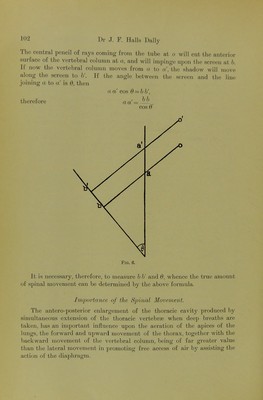
![rectification lessens from below upwards. Individual differences, however, are not infrequent. The straightening out of tlie thoracic curve, which occurs e.specially in that segment of the spine which articulates with the sixth, seventh, eighth, and ninth ribs, is due to contraction of the erector spina3 muscle which produces backward extension of the vertebral column, whilst at the same time the sternum is raised upwards and forwards by contrac- tion of the cervical and thoracic elevator muscles, thus bringing a larger costal arc into the place previously occupied by a smaller one, and so increasing the antero-posterior diameter of the thorax. Upon the ribs assuming a position of less obliquity, the spinal column, being far more limited in its possible range of movement than the sternum, on account of its multiple attachments, can only execute a fraction of the sternal move- ment. Towards the end of inspiration, as the movement of the sternum reaches its dynamic limit, the remainder of the force of the respiratory cycle is spent upon the spine, which accordingly, during the latter half of inspiration, shows progressive mobility. In inspiration the spinous processes are approximated and closely over- lap, thus forming a natural protection against hyper-extension of the vertebral column and conse(]uent injury to the cord. The bodies of the vertebrae show slight divergence anteriorly in consequence of the opening- out of the intervertebi’al discs, and the anterior common ligament is made taut. Correspondingly, the ribs are separated, and so the chest is enlarged in forward, outward, and upward diameters. In expii'ation the reverse takes place; the spinous processes separate, the bodies are approximated anteriorly, and the ribs are brought much nearer to each other. Measurement of the Spinal Movement. The spinal movement is best estimated by means of the orthodiagraph. 'I’lie subject is turned into the right or left lateral oblique position until the maximum area of transradiance and tlie greatest amount of luminosity are obtained between the shadow of the vertebral column behind and of the aorta in front. This involves a rotation through an angle of from 30 to 45 degrees. The shadow of the vertebral column forming the posterioi' boundary of tlie interval is then seen to move backwards and forwards rliythmically with respiration, the apparent movement being from (5 to 9 mm. Owing to the obliquity with which the normal incident pencil of rays strikes the anterior surface of the spine, the real movement in this instance is larger than the indicated movement. The exact amount of movement which the spine has undergone readily can be calculated as follows: .Suppose the anterior surface of the vertebral column to be at a.](https://iiif.wellcomecollection.org/image/b22419470_0015.jp2/full/800%2C/0/default.jpg)