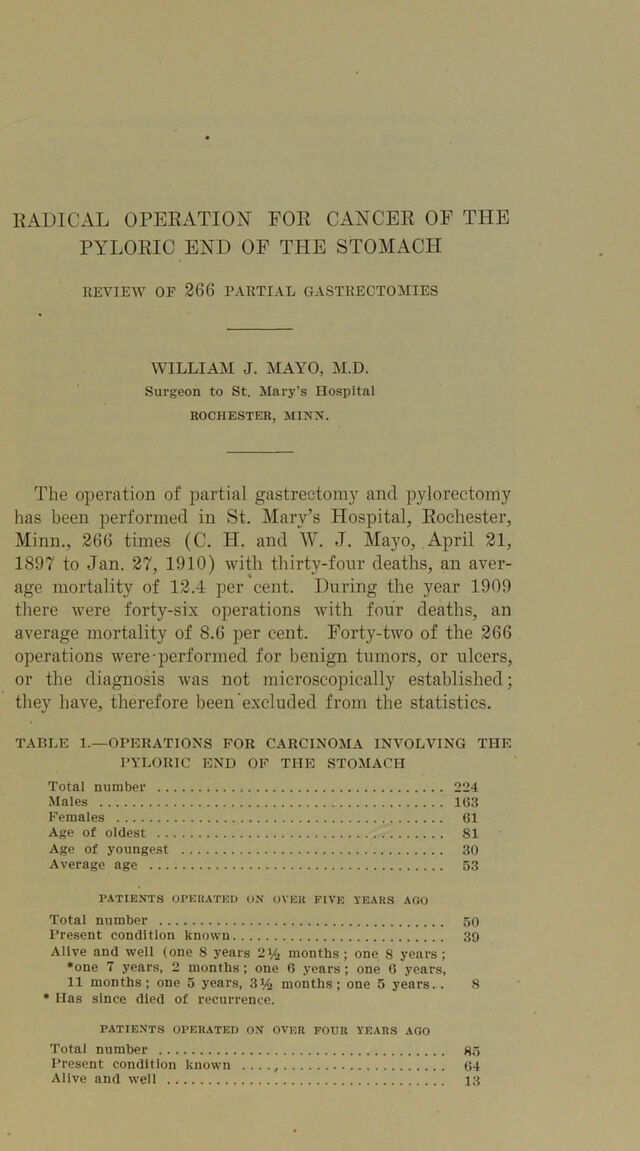
Radical operation for cancer of the pyloric end of the stomach : review of 266 partial gastrectomies / William J. Mayo.
- William James Mayo
- Date:
- 1910
Licence: In copyright
Credit: Radical operation for cancer of the pyloric end of the stomach : review of 266 partial gastrectomies / William J. Mayo. Source: Wellcome Collection.
Provider: This material has been provided by The Royal College of Surgeons of England. The original may be consulted at The Royal College of Surgeons of England.
5/16 page 5
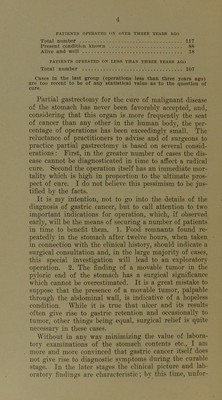
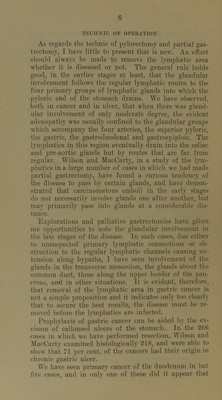
![tnnately, the ])rognosis is equally as plain as the diag- nosis, but, if the diseease is situated in the pyloric end of the stomach, it early introduces mechanical conditions which furnish the most valuable information.. Heretofore we have asked for a diagnosis in carcinoma of the stomach and have shifted the burden of responsi- bility to the internist. In the future let us ask, rather, for surgical consultation in all cases showing evidences of mechanical obstruction or tumor. So much can be said concerning the doubtful group of cancers from which we obtain our cases in which cure' is possible; but what shall be said as to the desirability of operation in advanced cases ? Partial gastrectomy of- fers a number of months of apparent cure, even when it is impossible to remove all of the involved lymphatics, and witli a mortality but slightly above that of gastro- jejunostomy which, at best, gives only a few months of more or less uncomfortable existence. Mikulicz has called special attention to the marked palliation which is produced by removal of the sloughing mass, as contrasted with methods which look only to overcoming the obstruction. In a high percentage of cases, cancer of the stomach is, at the first examination, plainly inoperable, and without exploration, other cases are doubtful. Palmer studied the histories of 335 patients suffering from cancer of the digestive tract, who presented them- selves at our clinic between Jan. 1, 1908 and Sept. 1, 1909, and found the following definite signs of meta- stasis: (1) implantation carcinoma of the sigmoid, “the rectal shelf of Blumer”; (2) supraclavicular metastasis; (3) carcinomatous involvement of the um- bilicus (buttonlike umbilicus); (4) free fluid in the peritoneum. These various conditions, by reason of the metastasis alone, eliminated about 12 per cent, of the total number as hopeless at the time of the primary examination. TABLE 2.—CASES OF CANCER OF THE STOMACH EXAMINED IN THE CLINIC BETWEEN JAN. 1, 1908, AND SEPT. 1, 1909 Total number 335 Hopeless and not admitted to the hospital 146 Resections 78 Gastrojejunostomies • 39 Excision malignant ulcer 2 Exploration inoperable disease 70 335](https://iiif.wellcomecollection.org/image/b22434355_0007.jp2/full/800%2C/0/default.jpg)