Resettlement policy and services for disabled people : a Department of Employment discussion paper for the National Advisory Council for the Employment of the Disabled.
- Department Of Employment
- Date:
- 1972]
Licence: Open Government Licence
Credit: Resettlement policy and services for disabled people : a Department of Employment discussion paper for the National Advisory Council for the Employment of the Disabled. Source: Wellcome Collection.
55/132 page 53
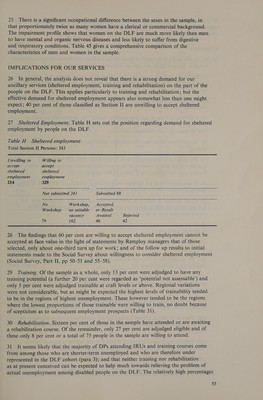
![25 There is a significant occupational difference between the sexes in the sample, in that proportionately twice as many women have a clerical or commercial background. The impairment profile shows that women on the DLF are much more likely than men to have mental and organic nervous diseases and less likely to suffer from digestive and respiratory conditions. Table 45 gives a comprehensive comparison of the characteristics of men and women in the sample. IMPLICATIONS FOR OUR SERVICES 26 In general, the analysis does not reveal that there is a strong demand for our ancillary services (sheltered employment, training and rehabilitation) on the part of the people on the DLF. This applies particularly to training and rehabilitation; but the effective demand for sheltered employment appears also somewhat less than one might expect; 40 per cent of those classified as Section HI are unwilling to accept sheltered employment. 27. Sheltered Employment. Table H sets out the position regarding demand for sheltered employment by people on the DLF. Table H_ Sheltered employment Total Section II Persons: 543 Unwilling to Willing to accept accept sheltered sheltered employment employment 214 329 Not submitted 241] Submitted 88 No Workshop, Accepted, Workshop no suitable or Result vacancy Awaited Rejected 79 162 46 42 28 The findings that 60 per cent are willing to accept sheltered employment cannot be accepted at face value in the light of statements by Remploy managers that of those selected, only about one-third turn up for work; and of the follow up results to initial statements made to the Social Survey about willingness to consider sheltered employment (Social Survey, Part I, pp 50-51 and 55-58). 29 Training. Of the sample as a whole, only 13 per cent were adjudged to have any training potential (a further 20 per cent were regarded as ‘potential not assessable’) and only 5 per cent were adjudged trainable at craft levels or above. Regional variations were not considerable, but as might be expected the highest levels of trainability tended to be in the regions of highest unemployment. These however tended to be the regions where the lowest proportions of those trainable were willing to train, no doubt because of scepticism as to subsequent employment prospects (Table 31). 30 Rehabilitation. Sixteen per cent of those in the sample have attended or are awaiting a rehabilitation course. Of the remainder, only 27 per cent are adjudged eligible and of these only 8 per cent or a total of 75 people in the sample are willing to attend. 31 It seems likely that the majority of DPs attending IRUs and training courses come from among those who are shorter-term unemployed and who are therefore under represented in the DLF cohort (para 3); and that neither training nor rehabilitation as at present conceived can be expected to help much towards relieving the problem of actual unemployment among disabled people on the DLF. The relatively high percentages](https://iiif.wellcomecollection.org/image/b32220108_0055.jp2/full/800%2C/0/default.jpg)
 No text description is available for this image
 No text description is available for this image
 No text description is available for this image