A dictionary of terms in art / edited and illustrated by F.W. Fairholt.
- Frederick William Fairholt
- Date:
- 1903
Licence: In copyright
Credit: A dictionary of terms in art / edited and illustrated by F.W. Fairholt. Source: Wellcome Collection.
69/488 (page 59)
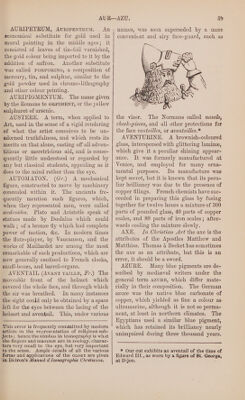
![AURIPETRUM, AvriPENtTRUM. economical substitute for gold used in mural painting in the middle ages; it consisted of leaves of tin-foil varnished, the gold colour being imparted to it by the addition of saffron. Another substitute was called PORPORINO, a composition of mercury, tin, and sulphur, similar to the gold powder used in chromo-lithography and other colour printing. AURIPIGMENTUM. The name given by the Romans to ORPIMENT, or the yellow sulphuret of arsenic. AUSTERE, <A term, when applied to Art, used in the sense of a rigid rendering of what the artist conceives to be un- adorned truthfulness, and which rests its merits on that alone, casting off all adven- titious or meretricious aid, and is conse- quently little understood or regarded by any but classical students, appealing as it does to the mind rather than the eye. AUTOMATON. (Gr.) A mechanical figure, constructed to move by machinery concealed within it. The ancients fre- quently mention such figures, which, when they represented men, were called androides. Plato and Aristotle speak of statues made by Deedalus which could walk ; of a bronze fly which had complete power of motion, &c. In modern times the flute-player, by Vaucanson, and the works of Maillardet are among the most remarkable of such productions, which are now generally confined to French clocks, snuff-boxes, and barrel-organs. AVENTAIL (Avant TAILLE, Ff.) The moveable front of the helmet which covered the whole face, and through which the air was breathed. © In many instances the sight could only be obtained by a space left for the eyes between the lacing of the helmet and aventail. ‘This, under various This error is frequently committed by modern artists in the representation of religious sub- jects; hence the nimbus in iconography is what the fingers and mamme are in zoology, charac- ters very small to the eye, but very important to the sense. Ample details of all the various forms and applications of the GLory are given ‘in Didron’s Manuel d [conographie Chretienne. convenient and airy face-guard, such as the visor. The Normans called nasals, cheek-pieces, and all other protections for the face ventailles, or aventailles.* AVENTURINE. A brownish-coloured glass, interspersed with glittering lamina, which give it a peculiar shining appear- ance. It was formerly manufactured at Venice, and employed for many orna- mental purposes. Its manufacture was kept secret, but it is known that its pecu- liar brilliancy was due to the presence of copper filings. French chemists have suc- ceeded in preparing this glass by fusing together for twelve hours a mixture of 300 parts of pounded glass, 40 parts of copper scales, and 80 parts of iron scales; after- wards cooling the mixture slowly. AXE. In Christian Art the axe is the attributes of the Apostles Matthew and Matthias. Thomas a Becket has sometimes the axe as an attribute, but this is an error, it should be a sword. AZURE. Many blue pigments are de- scribed by medizeval writers under the general term AZURE, which differ mate- rially in their composition. The German azure was the native blue carbonate of copper, which yielded as fine a colour as ultramarine, although it is not so perma- nent, at least in northern climates. The Egyptians used a similar blue pigment, which has retained its brilliancy nearly unimpaired during three thousand years. * Our cut exhibits an aventail] of the time of Edward III., as worn by a figure of St. George, at Dijon.](https://iiif.wellcomecollection.org/image/b31355481_0069.jp2/full/800%2C/0/default.jpg)