Dr. Baxter's report on an experimental study of certain disinfectants.
- Baxter, Evan Buchanan, 1844-1885.
- Date:
- [1875]
Licence: Public Domain Mark
Credit: Dr. Baxter's report on an experimental study of certain disinfectants. Source: Wellcome Collection.
Provider: This material has been provided by The Royal College of Surgeons of England. The original may be consulted at The Royal College of Surgeons of England.
13/42 (page 227)
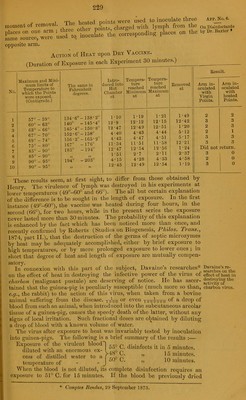
![room from a basin filled with chloride of lime, or the vapour of carbolic acid generated in a vaporiser, would be utterly inadequate to destioy vaccine virus, and, by inference, the contagium of small-pox, when embedded in a matrix of dried albuminous matter ; and it is not unlikely that the virulent matters for whose destruction aerial disinfection is employed are commonly protected in some such way,. The only experiments relating to the disinfection of vaccine virus of which I have been able to find any record, are those of Dr. Henry (1831), Mecklenburgh, and Dougall. None of these observers appear to have investigated the action of destructive agents upon the dried virus, and some of their results are open to question ; but the exceeding dearth of facts Avill not allow of any experimental data being neglected. Mecklenburgh,* in a preliminary notice, makes the following asser- tions, without, however, giving any details as to the number of experiments performed or the methods employed : 1°. That the exposure of vaccine lymph, diluted with its own volume of glycerine, to the action of chlorine (under a bell-jar) for several hours, fails to impair its efficacy, as tested by subsequent inoculation. 2°. That pure lymph mixed with an equal volume of the aqua oxymuriatica\ of the Prussian Pharmacopoeia, yields normal vesicles when inoculated. 3°. That lymph similarly treated with impure acetic acid was found to have lost its infective power. 4°. That out of eight children inoculated with lymph which had been mixed with commercial carbolic acid (proportions not given), only three took. The mixture is stated to have reddened blue litmus (?). The promise made by the author to publish an extended series of similar experiments does not, so far as I can ascertain, appear to have been redeemed. Dr. John Dougall, in the course of a very interesting experimental inquiry, published in the Glasgow Medical Journal for November 1872 and February 1873, performed 11 inoculations with vaccine which had been exposed to the action of certain volatile media. The method is thus described : “ To the separate vapours (contained in bell-jars of a cubic “ foot capacity) separate minims of vaccine lymph were exposed for “ 24 hours. The dry spot remaining was moistened with glycerine and “ water, its reaction taken, and the mixture sealed in capillary tubes “ till.an opportunity occurred for vaccinating a child with it. All the “ mixture was used in one insertion so as to make sure of obtaining its “ full effect. The lymph in every instance was at first alkaline, and “ the glycerine neutral.” Inoculation yielded characteristic vesicles when performed with lymph which had been exposed to the action of the following vapours: carbolic acid, camphor, chloroform, sulphuric ether, and iodine. On the other hand the virus acted upon by chlorine, sulphur dioxide, nitrous acid, glacial acetic acid, and hydrochloric acid] proved absolutely barren. Dr. Dougall draws attention to the important circumstance that the mixture of lymph and glycerine, in every case in which it had retained infective power, was either alkaline or neutral- while in every case in which it had been successfully disinfected its reaction was decidedly acid. The general tenour of these results is in harmony with those arrived at in the course of the present inquiry. The apparent failure of carbolic acid is deserving, however, of a moment’s consideration. Owiim- to an accident the vaccine was exposed to the carbolic vapour for 36 instead of 24 hours. Tim experiment was performed in hot weather (August). Somewhat surprised at the failure of so powerful an agent, Dr. Dougall * Merlin. Kim. Wochensclirift, 21 June I860. t This is a solution of chlorine, containing about ‘4 par cent, of the gas. Arr. No. 6. On Disinfectants by Dr. Baxter. Results obtained by Mecklen- burgh. Experiments performed by Dr. Dougall.](https://iiif.wellcomecollection.org/image/b22443228_0015.jp2/full/800%2C/0/default.jpg)