Dr. Baxter's report on an experimental study of certain disinfectants.
- Baxter, Evan Buchanan, 1844-1885.
- Date:
- [1875]
Licence: Public Domain Mark
Credit: Dr. Baxter's report on an experimental study of certain disinfectants. Source: Wellcome Collection.
Provider: This material has been provided by The Royal College of Surgeons of England. The original may be consulted at The Royal College of Surgeons of England.
17/42 (page 231)
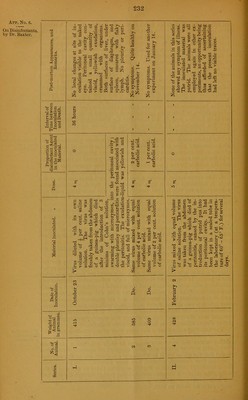
![its full specific effect, or uo effect at all. It is right to add, howevei, that in each individual series of experiments, virus from the same, source, diluted to the same extent, and in exactly the same dose, was injected into each of the animals. Further, that in every series the virulence of the unmodified liquid was established by a control experiment. Guinea-pigs were employed in preference to rabbits for several reasons. A number of experiments made on rabbits turned out to be valueless owing to the very capricious and uncertain tenure on which these rodents hold their life. Some die suddenly without apparent cause; others survive the inoculation of liquids which prove rapidly fatal to their fellows ; and the accidental death or survival of any one animal out of a series vitiates the result of the series as a whole. Again, the rabbits which succumb do not exhibit very definite structural lesions, so that it is often impossible to say whether a given animal has died in consequence of inoculation, or from some collateral and unknown cause. Guinea-pigs are more hardy ; they do not commonly die without]appreciable cause ; and the inoculation of virulent liquids produces in them tolerably definite and constant structural alterations. The lesions resulting from the injection of minute quantities of the above-described virus into the subcutaneous areolar tissue of the guinea- pig are never co-extensive with the tract of tissue presumably infiltrated with the liquid introduced; they either spread far beyond its limits, or else involve secondarily the great serous cavities. The appearances noticed may be roughly grouped under one or other of the following heads :— 1. The subcutaneous areolar tissue over a very large portion of the body is infiltrated with a thin, reddish, fetid liquid, swarming with microzymes; the skin is thus detached from the underlying parts and may become necrosed; the muscles are often discoloured and friable, looking as if macerated. Internal inflammations are absent. 2a. With a variable, though never very considerable, degree of local inflammation, there are all the signs of peritonitis ; the intestines more or less glued together, the liver smeared with yellowish lymph, perhaps adherent to the diaphragm. A quantity, usually small, of viscid exudation, crowded with microzymes, occupies the most dependent part of the abdominal cavity. 2b. In addition to the peritonitis, similar marks of inflammation arc seen in one or both pleura;, and in the pericardium. No very definite conclusions were arrived at concerning the im- mediate cause by which the occurrence of one set of appearances rather than of another was determined. One point stood out clearly,,viz., that the difference in degree and character of the inflammatory changes was associated with some peculiarity of the material inoculated, and not with any idiosyncrasy of the animals. Virus from the same source always caused appearances ol the same kind ; and the existence of very exten- sive cellulitis was always found to coincide with the absence of serous inflammations. When the serous membranes were involved the peri- toneum was always the first to suffer; the pleurisy and pericarditis being always subsequent in the order of their evolution. The following table gives a summary view of the results obtained bv allowing the four disinfectants to act on the virus. The leno-th of time during which the virus was exposed to their influence varied from 60 minutes to three hours; this point appeared unimportant, since it was found that the action could be effectually completed within five minutes provided that thorough mixture had been insured. The inoculations wore invariably performed in the subcutaneous tissue on one side of the hf P° ri a 1 r.UVftz’S fringe being pushed through the skin lial n ch fr°m the spinous processes of the vertebral, and downwards for about an inch. passee App. No. G. On Disinfectants, by Dr. Baxter. Lesions resulting from successful inoculation. Tabular view of experiments performed.](https://iiif.wellcomecollection.org/image/b22443228_0019.jp2/full/800%2C/0/default.jpg)