Volume 1
Report / Royal Commission on Civil Liability and Compensation for Personal Injury.
- Great Britain. Royal Commission on Civil Liability and Compensation for Personal Injury
- Date:
- 1978
Licence: Open Government Licence
Credit: Report / Royal Commission on Civil Liability and Compensation for Personal Injury. Source: Wellcome Collection.
36/568 page 18
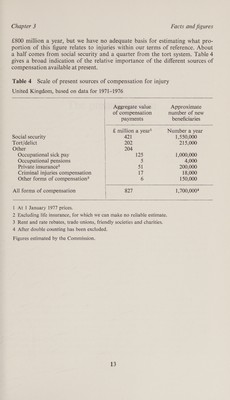
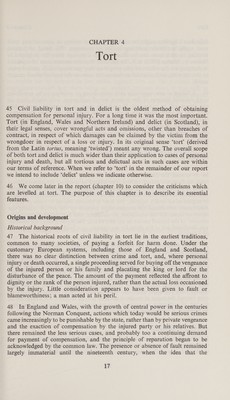
![Tort Chapter 4 defendant’s liability might be modified began to emerge in cases arising from road traffic accidents involving horses or carriages. The trend of judicial thinking in such cases can be illustrated by a passage from the judgment in Holmes v. Mather (1875) L.R. 10 Ex. 261, ‘For the convenience of mankind in carrying on the affairs of life, people as they go along roads must expect, or put up with, such mischief as reasonable care on the part of others cannot avoid’. 49 A failure to use reasonable care when doing or omitting to do something is an essential element in the modern test of negligence, with which much of our report will be concerned. It gradually came to be applied more widely than just in traffic cases. An early example had been the Fires Prevention (Metropolis) Act 1774, which had substituted liability for fault for the previous strict liability in respect of the escape of fire. By the end of the nineteenth century, liability for fault had largely superseded the stricter liability of the past. 50 Northern Ireland law is based to a large extent on the principles of English common law. 51 In Scotland, the modern test of negligence emerged by a different path. In or around the fourteenth century, when any personal injury or death resulting from the act of another was treated as a crime, the quasi-criminal action of assythment became established. Originally, assythment was available as a remedy for the victim himself, if he survived, or for his relatives, if he died, in respect of all bodily injuries; but later it became limited to cases of death. Assythment constituted the compensation payable by the person causing the injury or death for the mutilation or slaughter, and for ‘the pacifying of the rancour’ of the injured person or his next of kin. The modern claim for solatium was developed out of the claim for assythment, as a head of damages in purely civil actions. 52 In the meantime, by the beginning of the eighteenth century, accidental or negligent acts had become characterised as civil rather than criminal, and the action of assythment was falling into disuse. At the end of the century, the principle of reparation for fault emerged to fill the gap. Several of the early successful actions related to injuries incurred by falling into unfenced pits and drains during the construction of the Edinburgh new town. To the extent that they encompassed negligence by omission (an omission to fence off pits and drains) these and other cases also extended the scope of potential reparation even beyond the range of medieval criminal law. In England, the emergence of the test of negligence represented in some respects a contraction of liability. In Scotland, it represented an expansion. Donoghue v. Stevenson 53 The Classic statement of the principles behind the test of negligence, applicable throughout the United Kingdom, is in the speech of Lord Atkin in the Scottish case of Donoghue vy. Stevenson [1932] A.C. 562, 1932 S.C.(H.L.) 31.](https://iiif.wellcomecollection.org/image/b32222452_0001_0036.jp2/full/800%2C/0/default.jpg)



 No text description is available for this image
 No text description is available for this image
 No text description is available for this image