Sketch of the medical history of the native army of Bombay, for the year 1874. : [The regiments are placed as they stood in the army list of the 1st July 1874].
- Bombay (Presidency). Military Department.
- Date:
- 1875
Licence: Public Domain Mark
Credit: Sketch of the medical history of the native army of Bombay, for the year 1874. : [The regiments are placed as they stood in the army list of the 1st July 1874]. Source: Wellcome Collection.
Provider: This material has been provided by London School of Hygiene & Tropical Medicine Library & Archives Service. The original may be consulted at London School of Hygiene & Tropical Medicine Library & Archives Service.
372/396 page 324
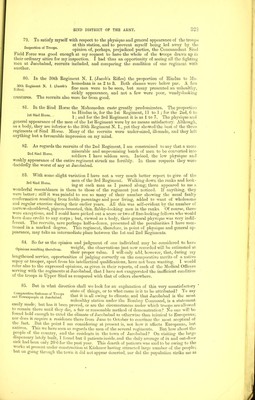
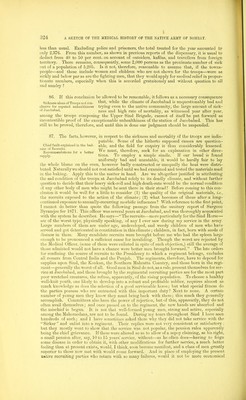
![less than usual. Excluding police and prisoners, the total treated for the year amounted to only 2,376. From this number, as shown in previous reports of the dispensary, it is usual to deduct from 40 to 50 per cent, on account of outsiders, kafilas, and travellers from foreign territory. There remains, consequently, some 2,000 persons as the proximate number of sick out of a population of 5,205. Is it not, therefore, reasonable to assume that, if the towns- people—and these include women and children who are not shown for the troops—were as sickly and below par as are the fighting men, that they would apply for medical relief in propor- tionate numbers, especially when this is accorded gratuitously and without question to all and sundry ? 86. If this conclusion be allowed to be reasonable, it follows as a necessary consequence Sickness alone of Troops not con- that, while the climate of Jacobabad is unquestionably bad and elusive for reputed unhealthiness trying even to the native community, the large amount of sick- of Jacobabad. ness an(] high rate of mortality, as witnessed year after year, among the troops composing the Upper Sind Brigade, cannot of itself be put forward as incontestible proof of the exceptionable unhealthiness of the station of Jacobabad. This has still to be proved, therefore, and until this is done our judgment should be suspended. 87. The facts, however, in respect to the sickness and mortality of the troops are indis- putable. Some of the hitherto supposed Causes are question- Chief fault explained in the bad- able, and the field for enquiry is thus considerably lessened 116RecoiIiMndations for a better We must> therefore, seek for an explanation in other direc- supply. tions. To employ a simple simile. If our bread is found uniformly bad and uneatable, it would be hardly fair to lay the whole blame on the oven, however badly constructed or unequally the heat were distri- buted. Naturally we should not rest satisfied until we had examined and tested the materials used in the baking. Apply this to the matter in hand. Are we altogether justified in attributing the sad condition of the troops at Jacobabad solely to its deadly climate, and without further question to decide that their heavy sick-roll and high death-rate would be the normal condition of any other body of men who might be sent there in their stead? Before coming to this con- clusion it would be well for a little to consider (1) the quality of the original materials, i.e., the recruits exposed to the action of the climate; (2) what becomes of these after a long- continued exposure to annually-recurring morbific influences ? With reference to the first point, I cannot do better than quote the following passage from the sanitary report of Surgeon Byramjee for 1871. This officer was several years at Jacobabad, and was thoroughly acquainted with the system he describes. BLe says—“ The recruits—more particularly for the Sind Horse—■ are of the worst type, physically speaking, of any I ever saw during my service in the army Large numbers of them are under age, undeveloped, and weedy children of men who have served and got deteriorated in constitution in this climate; children, in fact, born with seeds of disease in them. Many candidate recruits were brought before me who had the spleen large enough to be pronounced a sufficient cause for invaliding. Though the worst are rejected by the Medical Officer, (some of them were enlisted in spite of such objection,) still the average of those admitted would not have a chance were better men brought forward.” The late orders for confining the source of recruits to the Presidency to which a regiment belongs, excludes all comers from Central India and the Punjab. The regiments, therefore, have to depend for supplies upon Sind, the Konkan, the Southern Mahratta Country, and those born in the regi- ment—generally the worst of all. Good men in Sind do not, as a rule, present themselves for ser- vice at Jacobabad, and those brought by the regimental recruiting parties are for the most part poor wretched creatures, the refuse, apparently, of the rising population. To choose a healthy well-knit youth, one likely to develop into a robust and profitable soldier, requires almost as much knowledge as does the selection of a good serviceable horse; but what special fitness do the parties possess who are entrusted with this important duty? Next to none. A certain number of young men they know they must bring back with them; this much they generally accomplish. Committees also have the power of rejection, but of this, apparently, they do not often avail themselves; and once passed on to the regiment, the new hands are absorbed and the mischief is begun. It is not that well-formed young men, strong and active, especially among the Mahomedans, are not to be found. During my tours throughout Sind I have seen hundreds of such; and 1 have sometimes asked them why they did not take service with the “ Sirkar ” and enlist into a regiment. Their replies were not very consistent or satisfactory ; but they mostly went to show that the service was not popular, the pension rules apparently being the chief grievance. If these were altered so as to allow of a sepoy claiming, as his right, a small pension after, say, 10 to 15 years’ service, without—as he often does—having to feign some disease in order to obtain it, with other modifications for further service, a much better feeling than at present exists, would, I think, soon become manifest, and a class of men greatly superior to those now met with would come forward. And in place of employing the present native recruiting parties who return with so many failures, would it not be more economical](https://iiif.wellcomecollection.org/image/b24915543_0380.jp2/full/800%2C/0/default.jpg)