Anatomy, descriptive and surgical / by Henry Gray ; teh drawings by H.V. Carter ; with additional drawings in the second and later editions by Dr. Westmacott ; the dissections jointly by the author and Dr. Carter ; with an introd. on general anatomy and development, by T. Holmes.
- Henry Gray
- Date:
- [1877]
Licence: Public Domain Mark
Credit: Anatomy, descriptive and surgical / by Henry Gray ; teh drawings by H.V. Carter ; with additional drawings in the second and later editions by Dr. Westmacott ; the dissections jointly by the author and Dr. Carter ; with an introd. on general anatomy and development, by T. Holmes. Source: Wellcome Collection.
Provider: This material has been provided by the Francis A. Countway Library of Medicine, through the Medical Heritage Library. The original may be consulted at the Francis A. Countway Library of Medicine, Harvard Medical School.
58/974
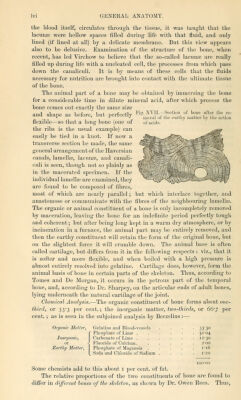
![the blood itself, circulates through the tissue, it was taught that the lacunae were hollow spaces filled during life with that fluid, and only lined (if lined at all) by a delicate membrane. But this view appears also to be delusive. Examination of the structure of the bone, when recent, has led Virchow to believe that the so-called lacunte are really filled up during life with a nucleated cell, the processes from which pass down the canaliculi. It is by means of these cells that the fluids necessary for nutrition are brought into conta.ct with the ultimate tissue of the bone. The animal part of a bone may be obtained by immersing the bone for a considerable time in dilute mineral acid, after which process the bone comes out exactly the same size and shape as before, but perfectly ^'S- XVIL-Section of bone after the re- ■■■ 7 tr J moval oi tne earthy matter by the action flexible—so that a long bone (one of of acids. the ribs is the usual example) can -s^ easUy be tied in a knot. If now a _^^®>*_,f^^^?^ ..mi!^^^^^\ transverse section be made, the same ^^^^^^^^^^H^^^^^^& general arrangement of the Haversian w^^S^^^^^^^^S^^^^ canals, lamellae, lacunae, and canal i- , •--?!--—-' - VIl' ' ''' ,^ euli is seen, though not so plainly as i _ ] in the macerated specimen. If the v^V^ ' ) individual lamellEe are examined, they ^- ^ - , ^ are found to be composed of fibres, most of which are nearly j)arallel; but which interlace together, and anastomose or communicate with the fibres of the neighbouring lamellae. The organic or animal constituent of a bone is only incompletely removed by maceration, leaving the bone for an indefinite period perfectly tough and coherent; but after being long kept in a warm dry atmosphere, or by incineration in a furnace, the animal part may be entirely removed, and then the earthy constituent will retain the form of the original bone, but on the slightest force it will crumble down. The animal base is often called cartilage, but differs from it in the following res23ects : viz., that it is softer and more flexible, and when boiled with a high pressure is almost entirely resolved into gelatine. Cartilage does, however, form the animal basis of bone iu certain parts of the skeleton. Thus, according to Tomes and De Morgan, it occurs in the petrous part of the temporal bone, and, according to Dr. Sharpey, on the articular ends of adult bones, lying underneath the natural cartilage of the joint. Chemical Analysis.—The organic constituent of bone forms about one- third, or 333 per cent.; the inorganic vaniter, two-thirds, or 66'2 per cent.; as is seen iu the subjoined analysis by Berzelius:— Organic Matter, Gelatine and Blood-vessels .... 33'30 {Phosphaie of Lime 51 '04 Carbonate of Lime il'3o Fluoride of Calcium. ..... 2-oo Phosphate of Magnesia it6 Soda and Chloride of Sodium . . . . i 20 lOO'OO Some chemists add to this about i per cent, of fat. The relative proportions of the two constituents of bone are found to differ in different hones of the skeleton, as shown by Dr. Owen Eees. Thus,](https://iiif.wellcomecollection.org/image/b21055087_0058.jp2/full/800%2C/0/default.jpg)