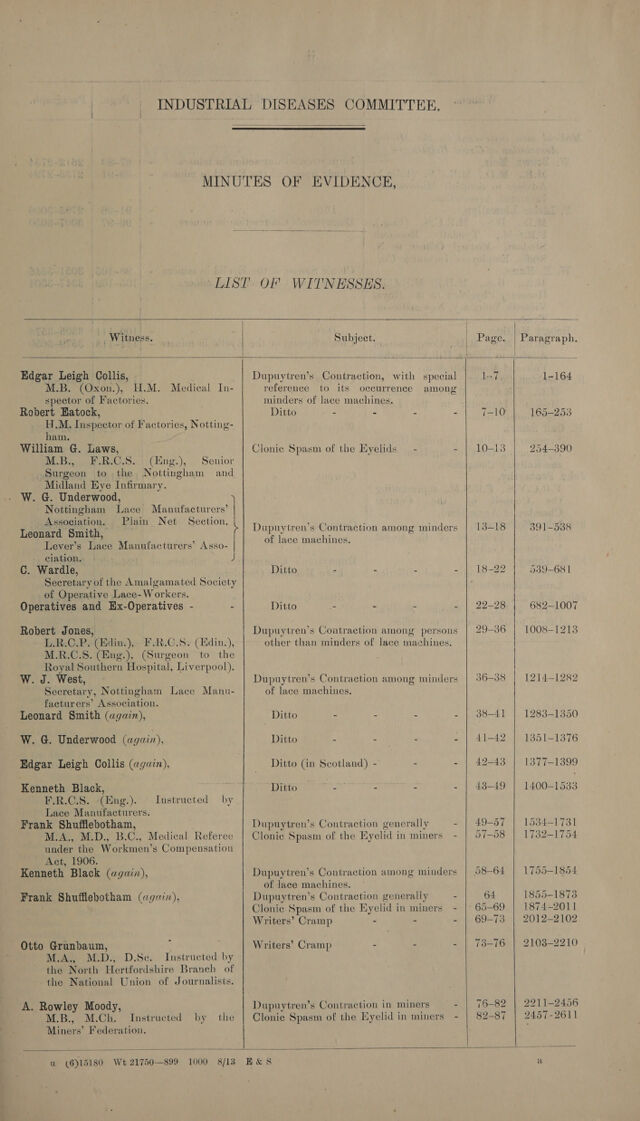
Minutes of evidence of the departmental committee appointed to inquire and report whether the following diseases can properly by added to those enumerated in the third schedule of the Workmen's Compensation Act, 1906 : namely: (1) cowpox, (2) Dupuytren's Contraction, (3) Clonic spasm of the eyelids, apart from nystagmus, (4) writers' cramp.
- Great Britain. Departmental Committee on Compensation for Industrial Diseases
- Date:
- 1913
Licence: Public Domain Mark
Credit: Minutes of evidence of the departmental committee appointed to inquire and report whether the following diseases can properly by added to those enumerated in the third schedule of the Workmen's Compensation Act, 1906 : namely: (1) cowpox, (2) Dupuytren's Contraction, (3) Clonic spasm of the eyelids, apart from nystagmus, (4) writers' cramp. Source: Wellcome Collection.
31/180 page 27
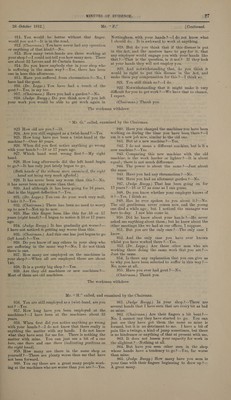
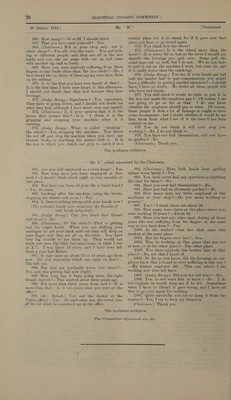
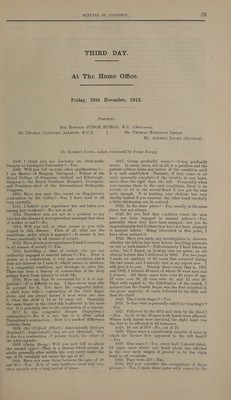
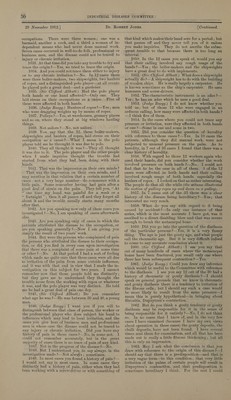
![26 October 1912.] [ Condinmed. 911. You would be better without that finger, would you not ?—It is in the road. 912. (Charrman.) Youhave never had any operation or anything of that kind P—No. 913. How many twist-hands are there working at your shop ?—TI could not tell youhow many men. There are about 32 Levers and 40 Curtain frames. 914. Do you know anybody else in your shop who is suffering in the same way ?—Yes, there has been one in here this afternoon. 915. Have you suffered from rheumatism ?—No, I have had the gout. 916. (Dr. Legge.) You have had a touch of the gout P—Yes, in my toe. 917. (Chairman.) Have you had a garden ?—No. 918. (Judge Ruegg.) Do you think now if you left your work you would be able to get work again in Nottingham, with your hands P—I do not know what I should do, It is awkward to work at anything. 919. But do you think that if this disease is put in the Act, and the masters have to pay for it, that any employer would engage you with your hands like that ?—That is the question, is it not? If they look at your hands they will not employ you. 920, And notwithstanding that, do you think it would be right to put this disease in the Act, and make them pay compensation for this >—I think so. 921. You still think so ?—I do. 922. Notwithstanding that it might make it very difficult for you to get work ?—We have that to chance, I expect. (Chairman.) Thank you. 923 How old are you P—58. 924. Are you still engaged as a twist-hand ?—Yes. 925. How long have you been a twist-hand at the machine ?—Over 40 years. 926. When did you first notice anything go wrong with your hands ?—16 or 17 years ago. 927. Which hand went wrong first ?—My right hand. 928. How long afterwards did the left hand begin to go?—It has only just lately began to go. (Both hands of the witness were examined, the right hand not being very much affected.) 929. It has never been any worse than this ?—No, it has never been any worse than that: 930. And although it has been going for 16 years, that is the biggest deflection ?—Yes. 931. (Dr. Legge.) You can do your work very well, I take it ?—Yes. 932. (Chatrman.) There has been no need to worry up to now ?—Not up to now. 933. Has this finger been like this for 16. or 17 years (right hand) ?—I began to notice it 16 or 17 years ago. ‘ 934. (Judge Ruegg.) It has gradually got worse ?— I have not noticed it getting any worse than this. 935. (Chairman.) And this one has just begun to go (left hand) ?—Yes. 936. Do you know of any others in your shop who are suffering in the same way?—No, I do not think there is one. 937. How many are employed on the machines in your shop ?—When all are employed there are about 140. 938. It is a pretty big shop P—Yes. 939. Are they old machines or new machines ?P-— Most of them are old machines. 940. Have you changed the machines you have been working on during the time you have been there ?—I am. in a new job now, similar to the old one. 941. But at a new machine P—Yes. 942. I do not mean a different machine, but is it a new machine ?—Yes. 943. Comparing this new machine with the old machine, is the work harder or lighter ?—It is about equal; there is not much difference. 944, The power is about the same ?—Just about the same. 945. Have you had any rheumatism ?—No. 946. Have you had an allotment garden ?—No. 947, (Judge Ruegg.) That has been going on for 13 years ?—16 or 17 as near as I can guess. t 948. Do you know whether your employer knows of Yes, I think so. 949. Has he ever spoken to you about it ?—No. The old gentleman never comes now, and the young one died a while ago; but I noticed the manager was here to-day. I saw him come in. 950. Did he know about your hands ?—He never asked me anything about them ; but he knew about the other meetings like we had at our offices, I suppose. 951. But you are the only case ?—The only case I know, 952. And the only case you have ever known whilst you have worked there ?—-Yes. 953. (Dr. Legge.) Are these other men who are working there doing the same work that you are ?— Just the same. 954, Is there any explanation that you can give as to why you have been selected to suffer in this way ?— No, none at all. 955. Have you ever had gout P—No. (Chairman.) Thank you. it ? 956. You are still employed asa twist-hand, are you not ? —Yes. 957. How long have you been employed at the machines ?—I have been at the machines about 33 years. 958. When first did you notice anything go wrong with your hands ?—I do not know that there really is anything the matter with my hands. I do not know what they have sent for me for. There is nothing the matter with mine. You can just see a bit of a one here, one there and one there (indicating positions on the right hand). 959. How many are there in the same shop as yourself ?—There are plenty worse than me that have not been forward. 960. You say there are a great many people work- ing at the machines who are worse than you are ?—Yes. 961. (Judge Ruegg.) In your shop?—There are several hands that I have seen that are every bit as bad as mine. 962. (Chairman.) Are their fingers a bit bent P— No, I cannot say they have started to go. You can just see they have got them the same as mine is formed, but it is no detriment to me. I have a bit of pain like a twinge, a kind of jump sometimes, but there is no hindrance or anything of that at present with me, 963. It does not lessen your capacity for work in the slightest ?—Nothing at all. 964, But have you seen other men in the shop whose hands have a tendency to go?—Yes, far worse than mine. 965. (Judge Ruegg.) How many have you seen in your time with their fingers beginning to draw up ?— A great many.](https://iiif.wellcomecollection.org/image/b32182028_0031.jp2/full/800%2C/0/default.jpg)
 No text description is available for this image
 No text description is available for this image
 No text description is available for this image