Minutes of evidence of the departmental committee appointed to inquire and report whether the following diseases can properly by added to those enumerated in the third schedule of the Workmen's Compensation Act, 1906 : namely: (1) cowpox, (2) Dupuytren's Contraction, (3) Clonic spasm of the eyelids, apart from nystagmus, (4) writers' cramp.
- Great Britain. Departmental Committee on Compensation for Industrial Diseases
- Date:
- 1913
Licence: Public Domain Mark
Credit: Minutes of evidence of the departmental committee appointed to inquire and report whether the following diseases can properly by added to those enumerated in the third schedule of the Workmen's Compensation Act, 1906 : namely: (1) cowpox, (2) Dupuytren's Contraction, (3) Clonic spasm of the eyelids, apart from nystagmus, (4) writers' cramp. Source: Wellcome Collection.
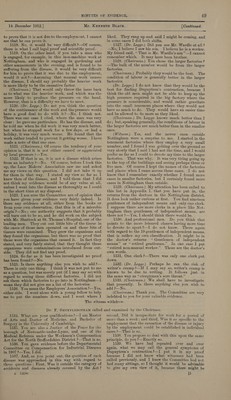
50/180 page 46
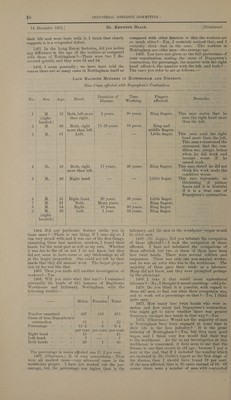
![4G 14 December 1912.] [ Continwed. their life and were born with it, I think that clearly suggests it is a congenital defect. 1461. In the Long Haton factories, did you notice any difference in the age of the workers as compared with those of Nottingham ’—There were two I dis- covered qutside, and they were 61 and 54. 1462. I mean generally; we have been told the yeason there are so many cases in Nottingham itself as’ compared with other districts is that the workers are so much older ?—Yes, I certainly noticed that, and I certainly think that is the case. The workers in Nottingham are older men—the average age. 1463. You have not given us the full particulars of your examination, stating the cases of Dupuytren’s contraction, the percentage, the number with the right hand affected, the number with the left, and both P— The cases you refer to are as follows:— - ! | i Duration of Time Fingers No. Box. dortAge es: Disease. Working. affected. sions hey 1 | M. 52 | Both, left more | 2years. | 30 years. Ring fingers. | This man states that he | (right- than right. | | ' uses the right hand more | handed.) | } than the left. Daa M. | 68 Both, right 15-20 years. | 58 years. Ring and | more than left. | middle fingers. 3 M. 61 Left. — oa Little finger. | This man used the right ; _ hand more than the left. | his man volunteered the _ statement that the con- | dition was always better _ when he did work and became worse if he | | ceased work. ! 4 M. 58 | Both, right 17 years. | 48 years. Ring fingers. | This man stated he did not more than left. | | think his work made the | | condition worse. EY 5 M. 43 | Right hand. | — | ae Little finger. | This case represents no | . . thickening of palmar | , fascia and it is doubtful | | if it is a true case of . _ Dupuytren’s contraction. 6 M. 51 | Right hand. 20 years. 30 years. Little finger. | i M. 61 Both. | Many years. | a Ring fingers. | 8 M. 54 Right. 10 years. | 30 years. | Ring finger. | 9 M. | 63 Left. | lyear. | 33 years. Ring finger. | (right- | | | . _ handed.) | | | 1464. Did any particular feature strike you in these cases ?—There is one thing, if I may say so, I was very struck with, and it was one of the first things, examining these lace machine minders, I found their hands for the most part as soft as my own. Whether it was due to the oil or not, I do not know, but they did not seem to have corns or any thickenings at all in the larger proportion. One could not tell by their hands that they did manual work. The larger propor- tion by far was like that. ~ 1465. Then you made still another investigation of workers ?—Yes. 1466. Will you state what that was ?—I examined personally the hands of 615 inmates of Bagthorpe Workhouse and Infirmary, Nottingham, with the following results :— — | Males. | Females.| Total. Number examined - 44.7 168 615 ©ases of true Dupuytren’s: contraction - : él a 52 Pereentage - - =) ‘hee 6 8°4 per cent. per cent. per cent. Right hand - - - 1 | — 15 Left hand - . - 7 — | 7 Both hands - . - 29 1 30 { : The percentage in males affected was 11-2 per cent. 1467. (Chairman.) It ‘is very astonishing—They were all murked cases—very advanced cases in the workhouse proper. I have not worked out the per- centage, but the percentage was higher than in the infirmary, and the men in the workhouse »roper would be older men. . 1468. (Dr. Legge.) Did you tabulate the occupation of those affected ?—I took the occupation of those affected. I have not tabulated the occupations of those affected, but two or three of them have been lace twist hands. There were several colliers and carpenters. There was only one non-manual worker, and he was an actor who was in the workhouse. The majority of them gave their trade as a labourer. Many did not know, and they were prompted perhaps by the attendant. 7 7 1469. I take it that would mean agricultural labourer ?—No; I thought it meant anything—odd jobs. 1470. Do you think it is possible, with regard to these 447 men, to find out what their occupation. was, and to work out a percentage on that ?—Yes, I think quite easy: hee 1471. How many lace twist hands who were in- mates, and how many had Dupuytren’s contraction. One might get to know whether there was greater frequency smongst lace hands in that way ?—Yes. 1472. (Chairman.) Would not the majority of men in Nottingham have been engaged at some time in their life in the lace industry? © It is the great industry of Nottingham ?—-Yes, but. they earn good wages, and I think very few would find their way to the workhouse. As far as my investigation at this workhouse is concerned, it does seem to me that the disease is one that occurs in old age; because I put a note at the end, that if I included the number which are included in Dr. Collis’s report as the first stage of the disease, then I should have found 19 per cent. of the men affected, that is, 85 cases instead of 51. Of course there were a number of men with contracted](https://iiif.wellcomecollection.org/image/b32182028_0050.jp2/full/800%2C/0/default.jpg)
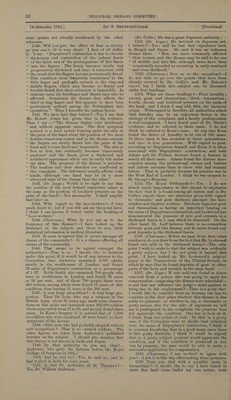
 No text description is available for this image
 No text description is available for this image
 No text description is available for this image