Minutes of evidence of the departmental committee appointed to inquire and report whether the following diseases can properly by added to those enumerated in the third schedule of the Workmen's Compensation Act, 1906 : namely: (1) cowpox, (2) Dupuytren's Contraction, (3) Clonic spasm of the eyelids, apart from nystagmus, (4) writers' cramp.
- Great Britain. Departmental Committee on Compensation for Industrial Diseases
- Date:
- 1913
Licence: Public Domain Mark
Credit: Minutes of evidence of the departmental committee appointed to inquire and report whether the following diseases can properly by added to those enumerated in the third schedule of the Workmen's Compensation Act, 1906 : namely: (1) cowpox, (2) Dupuytren's Contraction, (3) Clonic spasm of the eyelids, apart from nystagmus, (4) writers' cramp. Source: Wellcome Collection.
51/180 page 47
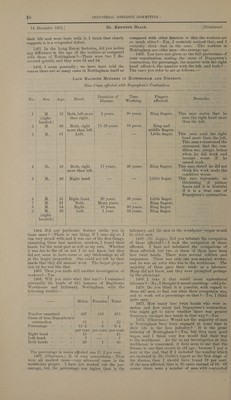
![14 December 1912.] hands due to a rheumatic affection without any con- traction of the palmar fascia at all, but I did not include those. 1473. You say you had only a little time to work up the subject ?—Yes. 1474. Perhaps you will say whether that can be carried further, because it will be useful >—Yes. 1475. With regard to the Nottingham General Hospital, how many cases of Dupuytren’s contraction have been admitted ?—There was one case during the seven years, 1905-1911, in 21,000 odd in-patients admitted. 1476. How have you got that information, because our information has been that it could not be obtained from the records P—I examined the actual books—the diagnoses made. 1477. Of the out-patients >—No, of the in-patients. In their report which they publish annually and in which they vive a list of the diseases, they have not stated any cases at all of Dupuytren’s contraction ; but I was not satisfied that that was sufficiently detailed to possibly state that, and I examined the registers themselves, because I was a resident there for a time. I remember one case. The one case quoted was a case while I was there. 1478. Was that admitted for operative treatment ? —Of course it is possible that some of the cases admitted for some other condition did have this disease. 1479. (Chativman.) Would they admit them for the disease per se ?—Yes, if necessary. 1480. (Dr. Legge.) But they would admit them for operation >—Yes, they would be labelled Dupuytren’s contraction, unless the diagnosis had been an error and they had been diagnosed “contracted finger,” and so on; but I do not think that occurred if it was true Dupuytren’s disease. 1481. You do not think it worth while to look at the out-patient records ?—The out-patient records at Nottingham Hospital are not very detailed, and I do not think it would have helped.” 1482. I quite understand. Can you compare those figures which you quote with those of any other hospital P—At St. Thomas’s Hospital, taking their detailed reports for a similar number of years—the actual years are not the same of course; they are 1903 to 1909—the reason of that is because 1 happen to have those reports and they stop at 1909, and I had the Nuttingham reports from 1905 to 1911, and so I took those—the number of cases in the same number of years that were admitted were 50,000 odd, and 21 cases of Dupuytren’s contraction; that is, one case to 2,390 in-patients. That might suggest that the disease is nine times less prevalent in the Nottingham Hospital than it is in St. Thomas’s Hospital; but [ do not think that evidence, if I may say so, is of any importance. I mean it does not prove it is nine times more common in London. It is possible London people pay more attention to it. 1483. But supposing that we could show that the disease occurred five times more frequently amongst lace workers than it dces in the industrial population of similar age, would that carry weight in your mind P —Yes, certainly, providing, of course, the cases are of similar age; and if they were examined in the same way. I think that would he rather suggestive. But, of course, if one man examines one group, and another man examines another group, there must be a good deal of difference of opinion—particularly the early stages— of what would be the actual disease. 1484. In those nine cases which you found amongst those working at machines, were there any whose wage-earning capacity was reduced }—I am afraid I did not go into that question at all, as to their wage- earning capacity. I did not inquire into that; I merely dealt with the medical side. 1485. Then, in addition to the interesting data that you have collected, did you go into the question of the operative treatment in connection with the disease — No, I cannot say I did at all. 1486. Will you let us have the conclusions drawn from your inquiry ?—Tbey are these :—Firstly : “ The * See Appendix II., p. xv. [ Continued. “ disease exists among the lace machine-minders, but “ it is doubtful that it is more prevalent in this than ‘in other trades.” I think I ought to add that my investigation is, of course, incomplete. To make an investigation valuable, I should personally have liked to examine under similar conditions a similar number of men in various trades, and a similar number of clergymen, doctors, and so on, before giving definite conclusions. I think those sort of conclusions then might be of some value, if one were able to do that. But when I say it is more prevalent in this than in other trades, that is the evidence I got from the Nottingham Hospital only finding one case, and other facts of the condition. Then the second conclusion is: “There is no evidence that the disease is more “ prevalent in Nottingham and surroundings than * elsewhere.’ Then, thirdly: “It would appear that ‘ Dupuytren’s contraction is a disease more pre- ‘* valent in the upper and middle classes or non- “ manual workers than among the labouring classes ‘ or manual workers in Nottingham and district, as it is elsewhere.” 1487. (Chatrman.) Why do you say that ?—From my examination, and from the returns I had from the doctors. It rather suggests that. Then, fourthly: * Little evidence can be found to support the theory * that the disease is caused or aggravated by local * friction or pressure.” Then, fifthly: “The known ‘** favts of the disease are all in favour of the causation “ being of constitutional, toxic, or microbic origin.” Certain writers investigated the question of the skin changes in the disease, and effects due to pressure; and one would expect the first part to be affected would be the outside skin, and then the deeper structures affected later. I have quoted the authorities who have examined the cases in that way microscopically. Ross states that the skin changes usually commence in the later stages of the disease. 1488. (Chairman.) We must take it, I suppose, as common knowledge—at least, I should think it would be—that the male portion of the population use their hands for rougher work a great deal more than the female P—Yes. 1489. Can you account for the striking difference between the appearance of this disease in males and females, except that it is due in some way to the use of the hands?—I do not know that I particularly noticed there was a striking difference. 1490. May I take your own figures in the work- house P—Do you mean, in the number ? 149]. Yes P—Yes.: 1492. Out of 447 cases of males there were 51 who were affected, and out of 168 females only one P—Yes, IT thought you meant the disease itself—whether it was diiferent. 1498. No, I mean the number ?—TI think it is a disease that occurs in males. 1494. Why ?—I do not know. 1495. If the origin is constitutional, as you rather suggest, can you suggest any reason why it should occur so much more frequently in males ?—TI think, if I may, I could give a somewhat similar analogy in mentioning cancer of the tongue. That is a disease which occurs in males almost exclusively. 1496. Is that not sometimes attributed to the masculine habit of smoking ?—It is said to be attri- buted to smoking; but it is preceded very often by chronic infiammation. 1497. However, you cannot account for that distinction *—No, 1 cannot. 1498. Does that not have some influence upon you in your opinion as to whether it is constitutional, or the usage of the hand—the use to which the hand is subjected in the male ?—No, I do not think so. 1499. In your second conclusion you say, ‘* There is ** no evidence that the disease is more prevalent in * Nottingham and its surroundings than elsewhere.” For that to be of value, you must make examinations elsewhere P—Yes. 1500. You very frankly said that that standing by itself is not of much value ?—No, it is not. . Pa](https://iiif.wellcomecollection.org/image/b32182028_0051.jp2/full/800%2C/0/default.jpg)
 No text description is available for this image
 No text description is available for this image
 No text description is available for this image