Minutes of evidence of the departmental committee appointed to inquire and report whether the following diseases can properly by added to those enumerated in the third schedule of the Workmen's Compensation Act, 1906 : namely: (1) cowpox, (2) Dupuytren's Contraction, (3) Clonic spasm of the eyelids, apart from nystagmus, (4) writers' cramp.
- Great Britain. Departmental Committee on Compensation for Industrial Diseases
- Date:
- 1913
Licence: Public Domain Mark
Credit: Minutes of evidence of the departmental committee appointed to inquire and report whether the following diseases can properly by added to those enumerated in the third schedule of the Workmen's Compensation Act, 1906 : namely: (1) cowpox, (2) Dupuytren's Contraction, (3) Clonic spasm of the eyelids, apart from nystagmus, (4) writers' cramp. Source: Wellcome Collection.
60/180 page 56
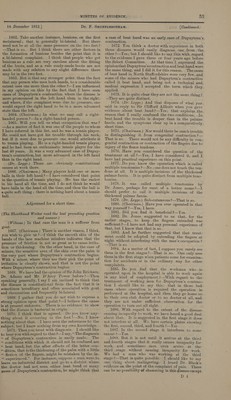
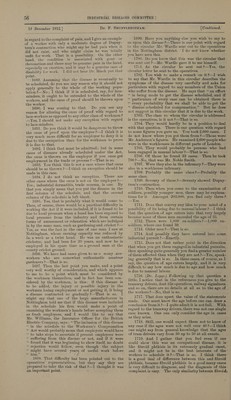
![14 December 1912.] [ Continued. in regard to the complaint of pain, and I give an example of a worker with only a moderate degree of Dupuy- tren’s contraction who might say he had pain when it did not exist, and who might claim he was totally unfit for work. That is a possibility. On the other hand, the condition is associated with gout or rheumatism and there may be genuine pain in the hand, especially on exertion, and it may be a genuine case of disability for work. I did not hear Dr. Black put that point. 1689. Assuming that the disease is eventually to be scheduled, do you see any reason why it should not apply generally to the whole of the working popu- lation 2—No; I think if it is scheduled, say, for lace- minders, it ought to be extended to the whole of the workers, and the onus of proof should be thrown upon the worker. 1690. I was coming to that. Do you see any reason for altering the onus of proof with regard to lace-workers as opposed to any other class of workmen ? Yes, I should not make any exception with regard to lace-minders. 1691. Do you think it would be dangerous to throw the onus of proof upon the employer ?—I think it is very much more difficult for an employer to deny it 1s due to the occupation than for the workman to prove it is due to that. 1692. I think that must be admitted; but in some cases of diseases already scheduled under the Act, the onus is thrown on the employer if you once get employment in the trade or process ?>—That is so. 1693. You think this is not a case where that onus should be so thrown ?—I think an exception should be made in this case. 1694. I do not think an exception. There are other cases where the onus is not on the employer ?— Yes; industrial dermatitis, trade eczema, is one. By that you simply mean that you put the disease in the first column of the schedule, and that the second column of the schedule is left blank. 1695. Yes, that is probably what it would come to Then, of course, there would be a practical difficulty in working the Act if it were included, if it is found to be due to local pressure when a hand has been exposed to local pressure from the industry and from certain forms of amusement or relaxation which are indulged in by the same man, such as gardening and cricket ?— Yes, as was the fact in the case of one man I saw at Nottingham, whose earning capacity was reduced by 5s. a week as a twist hand. He was an enthusiastic cricketer, and had been for 30 years, and now he is employed in his spare time as a ground man at the county cricket ground. 1696. We have had cases given to us 0 many -ace- workers who are somewhat enthusiastic amateur gardeners ?—That is so. 1697. Then the last point you make, and a point very well worthy of consideration, and which appears to me to be a point which must be considered by the workmen themselves, and in fact has been con- sidered by the workmen, is this: if this disease is to be added, the injury or possible injury in the workmen losing employment or not getting it, it being a disease contracted so gradually >—That is so. I might say that one of the large manufacturers in Nottingham told me that if this disease were included in the schedule his firm would make a point of examining the workmen’s hands before accepting them as fresh employees, and I would like to say that Mr. Williams, the Insurance Officer for the British Electric Company, says: ‘ The inclusion of this disease ‘** in the schedule to the Workmen’s Compensation Act would probably mean that employers would have * to take steps to ascertain if present employees were ‘ suffering from this disease or not, and if it were “ found that it was beginning to show itself, no doubt “ rejection would follow, even though the subject ’ ae have several years of useful work before * him.” 1698. That difficulty has been pointed out to the operatives’ representatives, but they say they are prepared to take the risk of that ?—I thought it was an important point. ae . 1699. Have you anything else you wish to say to us upon this disease P—There is one point with regard to the cirenlar Mr. Wardle sent out to the operatives in the Nottingham district. I do not know whether you have seen this. 1700. Do you know that this was the circular that was sent out ?—Mr. Wardle gave it to me himself. 17cl. As the circular he sent out ?—Yes, the circular letter he sent to the operatives. 1702. You wish to make a remark on it P—I wish to say that Mr. Wardle in this circular describes the symptoms of the disease very carefully and asks for particulars with regard to any members of the Union who suffer from the disease. He says that ‘“ an effort “is being made to get the disease scheduled, and if “ particulars of every case can be obtained there is “every probability that we shall be able to get the * disease scheduled for compensation.” But he does not suggest in this circular that it is due to the work. 1703. The class to whom the circular is addressed is the operatives, is it not >—That is so. | 1704. They would hardly be in a position to deal with that question. There is one question with regard to some figures you gave us. You took 2,600 cases. I do not know where you got them from ?—Those were Mr. Anderson's figures. He examined 2,600 people who were in the workhouses in different parts of London. 1705. They would probably be persons who had been engaged in manual labour ?—That is so. 1706. Of those he found 33 cases. Then he took 700 ?—No, that was Mr. Noble Smith. 1707. Were they also in the infirmary ?>—They were also in a workhouse infirmary. 1708, Probably the same class?—Probably the same class, 1709. Seventy of those >—Seventy showed Dupuy- tren’s contraction. 1710. Then when you come to the examination of soldiers, possibly younger men, there may be explana- tions for it. Amongst 203,000, you find only three ? —Yes. 1711. Does that convey any idea to your mind of a possibility of its being due to manual labour ?-—I think that the question of age enters into that very largely because none of these men exceeded the age of 35. © 1712. There were 1,000 ex-soldiers ?—1,000 ex- soldiers, where one found 39. 1713. Older men ?—That is so. 1714. And possibly they have entered into some industrial pursuit ?—Exactly. 1715. Does not that rather point in the direction that when you get them engaged in industrial pursuits, then speaking quite generally you finda greater number of them affected than when they are not ?—Yes, speak- ing generally that is so. In these cases, of course, as I say, the question of age enters largely, and it is very difficult to say how much is due to age and how much is due to manual labour. 1716. (Dr. Legge.) Following up that question a little, I notice that in the references you give to the tramway drivers, dust tile operatives, railway signalmen and so on, there are no details at all as to the age of the workers ?—No, that is so. 1717. That does upset the value of the statements made. One must know the age before one can draw a conclusion’ from it P—I quite admitit is notfull. With regard to the tramway drivers, there was not one single case known. One can only consider the age in cases as they arise. 1718. Still, one would expect them not to know of any case if the ages were not well over 40 ?—I think one might say from general knowledge that the ages of tram drivers vary from 30 up to 50 at all events. 1719. And I gather that you feel even if one could show this was an occupational disease, it is like fibroid phthisis in its extremely gradual onset, and it might not be in the best interests of the ' workers to schedule it?—That is so. I think there’ is a good deal of difference between this and fibroid phthisis, because fibroid phthisis in a good many cases is very difficult to diagnose, and the diagnosis of this complaint is easy. The only similarity between fibroid,](https://iiif.wellcomecollection.org/image/b32182028_0060.jp2/full/800%2C/0/default.jpg)
 No text description is available for this image
 No text description is available for this image
 No text description is available for this image