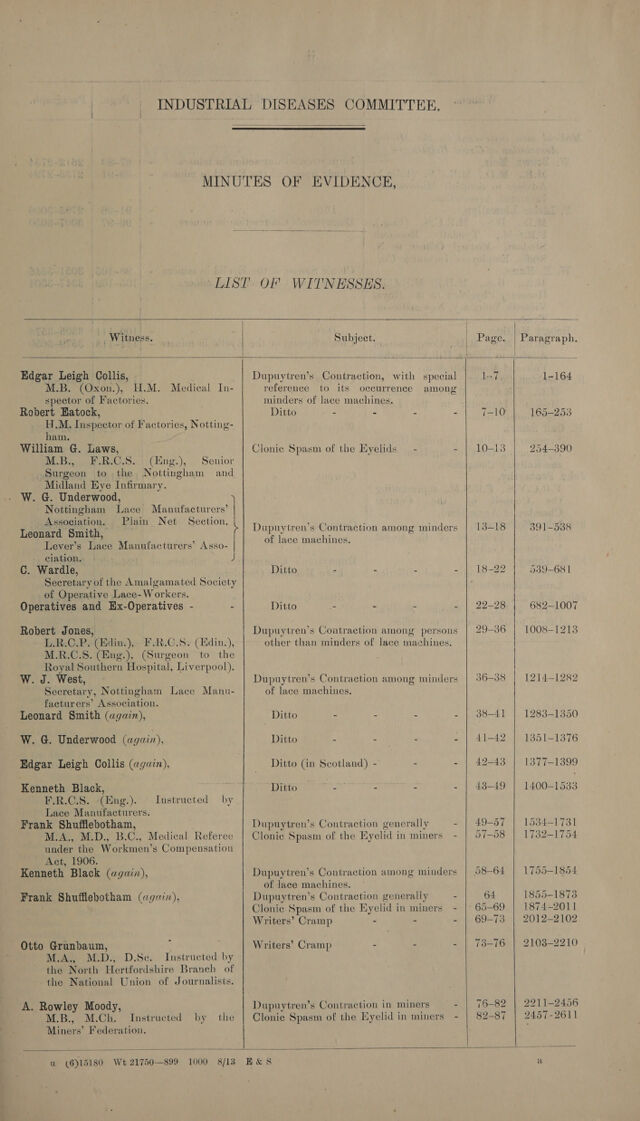
Minutes of evidence of the departmental committee appointed to inquire and report whether the following diseases can properly by added to those enumerated in the third schedule of the Workmen's Compensation Act, 1906 : namely: (1) cowpox, (2) Dupuytren's Contraction, (3) Clonic spasm of the eyelids, apart from nystagmus, (4) writers' cramp.
- Great Britain. Departmental Committee on Compensation for Industrial Diseases
- Date:
- 1913
Licence: Public Domain Mark
Credit: Minutes of evidence of the departmental committee appointed to inquire and report whether the following diseases can properly by added to those enumerated in the third schedule of the Workmen's Compensation Act, 1906 : namely: (1) cowpox, (2) Dupuytren's Contraction, (3) Clonic spasm of the eyelids, apart from nystagmus, (4) writers' cramp. Source: Wellcome Collection.
65/180 page 61
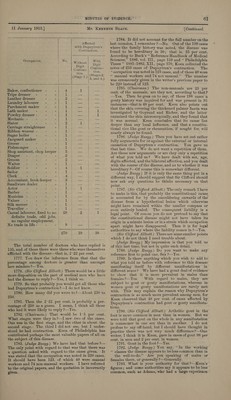
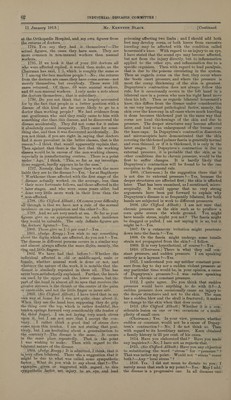
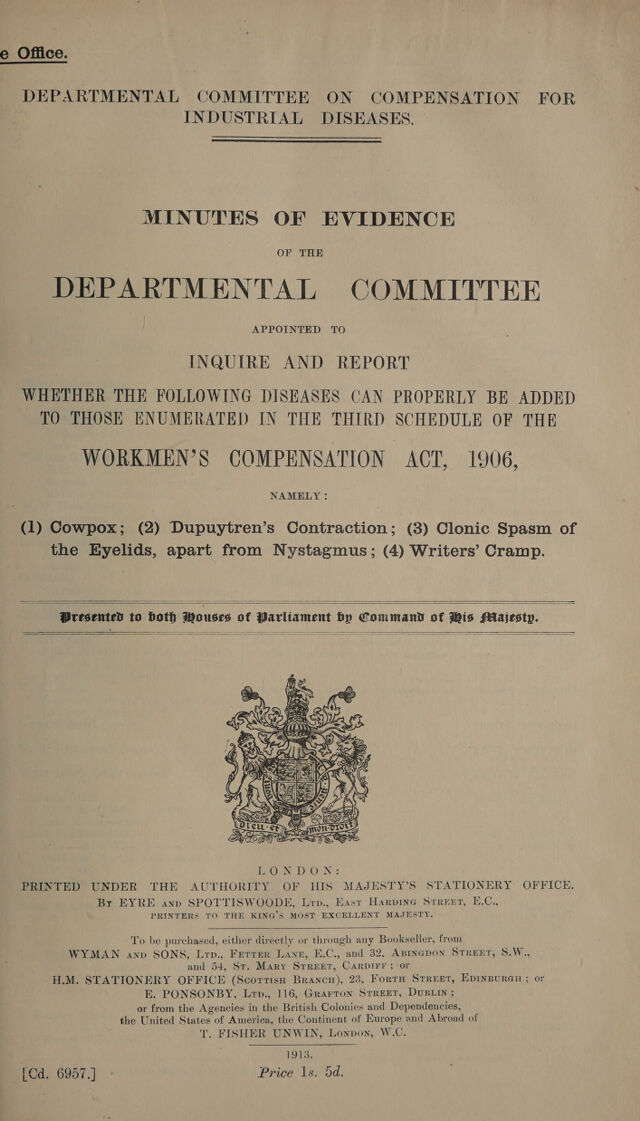
![A fected with Dupuytren’s Contraction. With Digit Contrac- tion. (Stages 2, 3, and 4.) r, Te Occupation. Teo ter a ae eae Digit Contrac- } tion. (Stage 1.) 2 a EE EEE EE eee eo Baker, confectioner - “ Tripe dresser - - - - Leather dresser - < Laundry labourer - - Parchment maker’ - 4 Lath maker : wake Powdry dresser - - - Mechanic - 2 - = Slater - : “ ‘ Carriage straightener : Ribbon weaver - 2 - Sugar boiler - - - Jacquard maker - “ Grocer - = 2 : Fishmonger — - Shop assistant, Draper - - - - Groom F b A : Waiter - 2 : E Soldier Sailor “ - 4 . Clerk - - - : Accountant, book- va a - Smallware dealer “ Actor - - = a Barber = - - = Musician - - - 2 Valuer - ‘ - - Silk mercer - - -.| Traveller - - = = Casual labourer, fixed to no definite trade, odd jobs, no regular employment. No trade in life - - a 9 } - - - - bo v2] os Ss ro re ® D ue) © ~ a ll ee en ee ORCC ee oe eee ae oom bo | 70 | 19 38 } The total number of doctors who have replied is afflicted with the disease—that is, 2°22 per cent. percentage among doctors is greater than amongst lace minders ?—Yes. more disposition on the part of medical men who. have had the disease to reply ?-—Yes, I think so. 1779. So that probably you would get all those who had Dupuytren’s contraction ?—I do not know. 1780. How many did you write to ?—About 230 to 250. 1781. Then the 2°22 per cent. is probably a per- centage of 250 asa guess: I mean, I think all those who had it were likely to reply ?—Yes. 1782. (Chairman.) That would be 1°5 per cent. What stages were they in?—I saw two of the cases. One was in the first stage, and the other in about the second stage. The thirdI did not see, but I under- stood he had contraction. the subject of this disease. 1783. (Judge Ruegg.) We have had that before ?— The only point with regard to that was that there was a question asked with regard to the cases given. It was stated that the occupation was noted in 220 cases, It should have been 123, of which 49 were manual workers and 74 non-manual workers. I have referred to the original papers, and the quotation is incorrectly given. rn 1784. It did not account for the full number on the last occasion, I.remember ?—No, Out of the 198 cases where the family history was noted, the disease was found to be hereditary in 50; that is, 25 per cent. According to Buck’s “ Reference Handbook of Medical Sciences,” 1886, vol. IIT., page 159 and “ Philadelphia Times ” 1881-1882 , XIT., page 370, Keen collected the notes of 253 cases of Dupuytren’s contraction. The ‘ occupation was noted in 123 cases, and of these 49 were * manual workers and 74 not manual.’”’ The number was erroneously given in the writer’s previous paper to be 220 instead of 123. 1785. (Chairman.) The non-manuals are 25 per cent. of the manuals, are they not, according to that ? —Yes. Then he goes on to say, of these 198 cases a gouty history was inquired for and was present in 95 instances—that is 48 per cent. Keen also points out that the skin covering the thickened palmar fascia was investigated by Goyrand and Richer, and the latter examined the skin microscopically, and they found that it was normal. Keen concludes that its cause lies deeper than any local influence, and that a constitu- tional vice like gout or rheumatism, if sought for, will nearly always be found. 1786. (Judge Ruegg.) Then you have set out rather fully arguments for or against the external or internal causation of Dupuytren’s contraction. You gave us that last time. We do not want a repetition of them. Are these new arguments or are they only a repetition ef what you told us? We have dealt with sex, age, digits affected, and the bilateral affection, and you dealt with the course of the disease, and as to whether it was (Judge Ruegg.) If it is only the same thing put ina different way, I shonld suggest that Sir Clifford should now ask any questions he thinks necessary on that point. 1787. (Sir Clifford Allbutt.) The only remark Ihave to make is this, that probably the constitutional cause is accounted for by the smouldering onwards of the disease from a hypothetical lesion which otherwise might have remained within the smaller compass or even entirely healed. The consequent liability is a legal point. Of course you do not pretend to say that the constitutional disease might not have taken its origin in a minute lesion or ina strain which occupation apart might have disappeared. Then it is for legal authorities to say where the liability comes in ?—Yes. (Sir Clifford Allbutt.) There are some smaller points which J do not think I need trouble about. (Judge Ruegg.) My impression is that you told us of this last time, but not in quite such detail. 1788. (Judge Ruegg.) Do you want to make any reference first to point one, Sex ?>—Yes. 1789. Is there anything which you wish to add to what you told us before with reference to this desease manifesting itself by different manifestations in’ different sexes? We have had a great deal of evidence’ to show that it is more prevalent in males than females ?—Yes. With regard to males, they are’ subject to gout or gouty manifestations, whereas in women gout or gouty manifestations are rarely met with. This may explain the reason why Dupuytren’s ' contraction is so much more prevalent among men, for Keen observed that 48 per cent. of cases affected by Dupuytren’s contraction had gout or gouty manifesta- tions. 1790. (Stir Clifford Allbutt.) Arthritic gout in the’ foot is more common in men than in women. But we were told that gout on the whole in any manifestation is commoner in one sex than in another. I do not profess to say off-hand, but I should have thought in ’ practice there was not very much difference ?—One writer, I think it is Keen, gave in cases of gout 98 per cent. in men and 2 per cent. in women. 1791. Gout in the foot P—Yes. 1792. (Judge Ruegg.) You say, “In the working’ ** classes the disease appears to be less common than in the well-to-do.” Are you speaking of males or females there, or generally ?—Generally. 1793. What is your authority for that ?—Keen’s figures; and some authorities say it appears to be less ° common, such as Adams, who had a large experience.](https://iiif.wellcomecollection.org/image/b32182028_0065.jp2/full/800%2C/0/default.jpg)
 No text description is available for this image
 No text description is available for this image
 No text description is available for this image