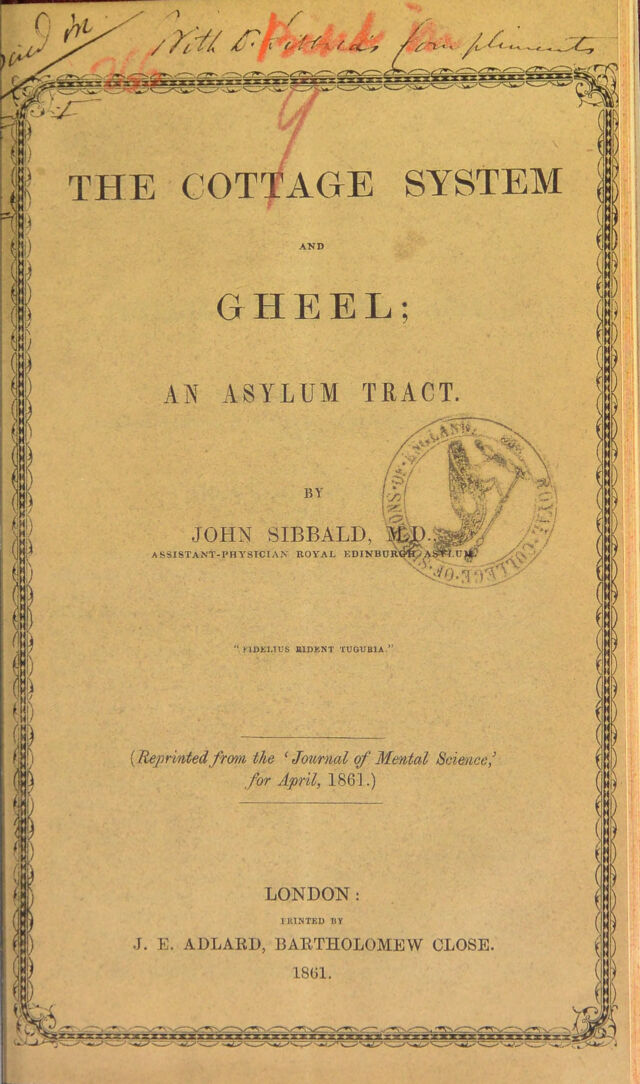
The cottage system and Gheel : an asylum tract / by John Sibbald.
- Sibbald, John, 1833-1905.
- Date:
- 1861
Licence: Public Domain Mark
Credit: The cottage system and Gheel : an asylum tract / by John Sibbald. Source: Wellcome Collection.
Provider: This material has been provided by The Royal College of Surgeons of England. The original may be consulted at The Royal College of Surgeons of England.
32/34 page 30
![inducements would be ])resented to them to throw themselves in the M'ay of temptations which are so dangerous to the unsetth^d mind. The great advantage w'hich this plan possesses in com- parison with the Belgian system is, that many of the cases suitable for cottage treatment are so only for very brief periods, being (dther in a probationary state between the asylum and the world at large, or liable to relapses which may render their transference to the main building at any time a measure of prudence or necessity. In Dr. Bucknill^s experiment this view of the requirements was illus- trated soon after its inauguration. “In one instance maniacal excitement came on. The superintendent was informed of it, and the patient was readmitted into the asylum without the least delay.” At the conference of German alienist physicians at Eisenach last September, the opinion seems to have been general that the system should be introduced, at least in the mean time, only in connexion with existing asylums. Before closing the review of tliis subject, I beg leave to refer to the recommendations contained in the ^Suggestions and Instructions’ in reference to the construction of asylums, issued by the General Board of Lunacy for Scotland, and pnbhshed in the Appendix to the fii’st Annual Eeport. The directions correspond so nearly with what I have ventured to suggest in the foregoing observations, that I gladly avail myself of their high authority in lending weight to my conclusions. In articles 6 and 32 it is remarked, that “ De- tached buildings of a cheap and simple character, consisting chiefly of associated day-rooms and dormitories, miglit be provided for the use of working patients. Eor the females these buildings might be placed in connexion with the washhonse and laundry; and for the males, be in proximity to the workshops and farm buildings. Provisions of an equally simple and inexpensive description might also be made for a portion of the idiotic, imbecile, and fatuous patients, and also for chronic cases; or cottages might be erected for the accommodation of a large proportion of the working and in- offensive, who might be placed either under the care of the families of the attendants or of cottar tenants of the asylum. The cottages, if adopted, should be of different sizes, each calculated to accommo- date from three to five patients, in addition to the family of the occupier. The male patients shonld be placed either in single rooms or in dormitories for three or four, and each cottage should contain a watercloset.” It will be interesting to watch the working of the cottage system in asylums erected according to this plan, and more especially if, in those situated in the more remote parts of the country, the experi- ment of boarding out patients can be so incorjiorated with it iis to aflbrd a fair trial to what at present seems to be the most satisfactory dcvelojnnent of the cottage sgdem.](https://iiif.wellcomecollection.org/image/b22342680_0034.jp2/full/800%2C/0/default.jpg)