Treatise on the diseases of the eye : including the anatomy of the organ / by Carl Stellwag von Carion ; tr. from the 3rd German ed. and ed. by Charles E. Hackley and D.B. St. John Roosa ; with an appendix by the editors.
- Karl Stellwag von Carion
- Date:
- 1870
Licence: Public Domain Mark
Credit: Treatise on the diseases of the eye : including the anatomy of the organ / by Carl Stellwag von Carion ; tr. from the 3rd German ed. and ed. by Charles E. Hackley and D.B. St. John Roosa ; with an appendix by the editors. Source: Wellcome Collection.
Provider: This material has been provided by the Francis A. Countway Library of Medicine, through the Medical Heritage Library. The original may be consulted at the Francis A. Countway Library of Medicine, Harvard Medical School.
24/810 page 2
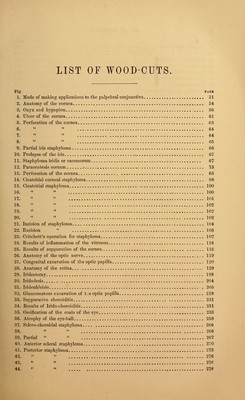
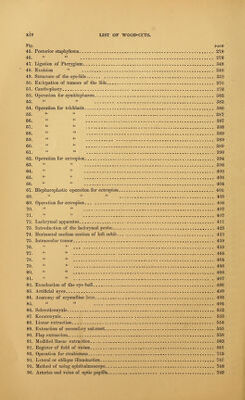
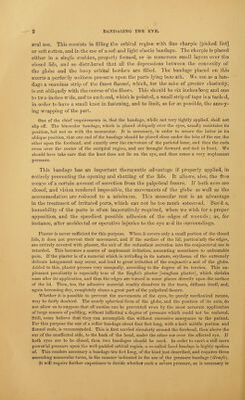
![eral use. This consists in filling the orbital region with fine charpie [picked lint] or soft cotton, and in the use of a soft and light elastic bandage. The charpie is placed either in a single cushion, properly formed, or in numerous small layers over the closed lids, and so distributed that all the depressions between the convexity of the globe and the bony orbital borders are filled. The bandage placed on this exerts a perfectly uniform pressure upon the parts lying beneath. We use as a ban- dage a seamless strip of the finest flannel, which, for the sake of greater elasticity, is cut obliquely with the course of the fibers. This should be six inches long and one to two inches wide, and to each end, which is pointed, a small strip of tape is a' tached, in order to have a small knot in fastening, and to limit, as far as possible, the annoy- ing wrapping of the part. One of the chief requirements is, that the bandage, while not very tightly applied, shall not slip off. The binocular bandage, which is placed obliquely over the eyes, usually maintains its position, but not so with the monocular. It is necessary, in order to secure the latter in its oblique position, that one end of the bandage should be placed close under the lobe of the ear, the other upon the forehead, and exactly over the curvature of the parietal bone, and then the ends cross over the center of the occipital region, and are brought forward and tied in front. We should here take care that the knot does not lie on the eye, and thus cause a very unpleasant •pressure. This bandage has an important therapeutic advantage if properly applied, in entirely preventing the opening and shutting of the lids. It allows, also, the free escape of a certain amount of secretion from the palpebral fissure. If both eyes are closed, and vision rendered impossible, the movements of the globe as well as the accommodation are reduced to a minimum. This muscular rest is an advantage in the treatment of irritated parts, which can not be too much esteemed. Bes:d.s, immobility of the parts is often imperatively required, when we wish for a proper apposition, and the speediest possible adhesion of the edges of wounds; as, for instance, after accidental or operative injuries to the eye and its surroundings. Plaster is never sufficient for this purpose. When it covers only a small portion of the closed lids, it does not prevent their movement, and if the surface of the lid, particularly the edges, are entirely covered with plaster, the exit of the redundant secretion into the conjunctival sac is retarded. This becomes a source of unpleasant irritation, amounting sometimes to unbearable ■pain. If the plaster is of a material which is irritaSng in its nature, erythema of the extremely delicate integument may occur, and lead to great irritation of the conjunctiva and of the globe. Added to this, plaster presses very unequally, according to the degree of its tension. This un- pleasant peculiarity is especially true of the English plaster [isinglass plaster], which shrinks soon after its application, and thus the edges are turned in some places directly upon the surface of the lid. Then, too, the adhesive material readily dissolves in the tears, diffuses itself, and, again becoming dry, completely closes a great part of the palpebral fissure. Whether it is possible to prevent the movements of the eyes, by purely mechanical means, may be fairly doubted. The nearly spherical form of the globe, and the position of its axis, do not allow us to suppose that all motion can be prevented even by the most accurate application of large masses of padding, without inflicting a degree of pressure which could not be endured. Still, some believe that they can accomplish this without excessive annoyance to the patient. For this purpose the use of a roller bandage about four feet long, with a knit middle portion and flannel ends, is recommended. This is first carried circularly around the forehead, then above the ear of the unaffected side, to the back of the head, under the other ear over the affected eye. If both eyes are to be closed, then two bandages should be used. In order to exert a still more powerful pressure upon the well-padded orbital region, a so-called laced bandage is highly spoken of. This renders necessary a bandage ten feet long, of the kind just described, and requires three ascending monocular turns, in the manner indicated in the use of the pressure bandage (Graefe). It will require further experience to decide whether such a severe pressure, as is necessary in](https://iiif.wellcomecollection.org/image/b2107902x_0024.jp2/full/800%2C/0/default.jpg)