Treatise on the diseases of the eye : including the anatomy of the organ / by Carl Stellwag von Carion ; tr. from the 3rd German ed. and ed. by Charles E. Hackley and D.B. St. John Roosa ; with an appendix by the editors.
- Karl Stellwag von Carion
- Date:
- 1870
Licence: Public Domain Mark
Credit: Treatise on the diseases of the eye : including the anatomy of the organ / by Carl Stellwag von Carion ; tr. from the 3rd German ed. and ed. by Charles E. Hackley and D.B. St. John Roosa ; with an appendix by the editors. Source: Wellcome Collection.
Provider: This material has been provided by the Francis A. Countway Library of Medicine, through the Medical Heritage Library. The original may be consulted at the Francis A. Countway Library of Medicine, Harvard Medical School.
42/810 page 20
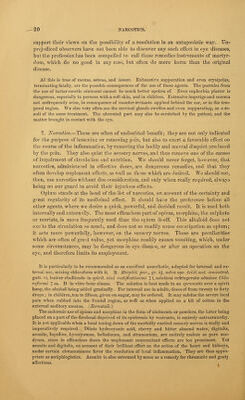
![support their views on the possibility of a resolution in an antagonistic way. Un- prejudiced observers have not been able to discover any such effect in eye diseases, but the profession has been compelled to call these remedies instruments of martyr- dom, which do no good in any case, but often do more harm than the original disease. All this is true of moxas, setons, and issues. Exhaustive suppuration and even erysipelas, terminating fatally, are the possible consequences of the use of these agents. The pustules from the use of tartar-emetic ointment cannot be much better spoken of. Even euphorbia plaster is dangerous, especially in persons with a soft skin, and in children. Extensive impetigo and eczema not unfrequently arise, in consequence of counter-irritants applied behind the ear, or in the tem- poral region. We also very often see the cervical glands swollen and even suppurating, as a re- sult of the same treatment. The ulcerated part may also be scratched by the patient, and the matter brought in contact with the eye. 7. Narcotics.—These are often of undoubted benefit; they are not only indicated for the purpose of lessening or removing pain, but also to exert a favorable effect on the course of the inflammation, by removing the bodily and mental disquiet produced by the pain. They also quiet the sensory nerves, and thus remove one of the causes of impairment of circulation and nutrition. We should never forget, however, that narcotics, administered in effective doses, are dangerous remedies, and that they often develop unpleasant effects, as well as those which are desired. We should not, then, use narcotics without due-consideration, and only when really required, always being on our guard to avoid their injurious effects. Opium stands at the head of the list of narcotics, on account of the certainty and great regularity of its medicinal effect. It should have the preference before all other agents, where we desire a quick, powerful, and decided result. It is used both internally and externally. The most efficacious part of opium, morphine, the sulphate or muriate, is more frequently used than the opium itself. This alkaloid does not exe'te the circulation so much, and does not so readily cause constipation as opium; it acts more powerfully, however, on the sensory nerves. These are peculiarities which are often of great value, yet morphine readily causes vomiting, which, under some circumstances, may be dangerous in eye disease, or after an operation on the eye, and therefore limits its employment. It is particularly to be recommended as an excellent anaesthetic, adapted for internal and ex- ternal use, mixing chloroform with it. ]J. Morpliii pur., gr. iij, solve ope Acidi acet. concentrat. gutt. vi, leniter ebulliendo in spirit, vini rectificatissimi 3 i, solutioni refringeratee admisce Ghlo- roformi 3 ss. D in vitro bene clauso. The solution is best made in an eprouvette over a spirit lamp, the alcohol being added gradually. For internal use in adults, doses of from twenty to forty drops ; in children, ten to fifteen, given on sugar, may be ordered. It may subdue the severe local pain when rubbed into the frontal region, as well as when applied on a bit of cotton in the external auditory meatus. {JBematzih.) The endermic use of opium and morphine in the form of ointments or powders, the latter being placed on a part of the forehead deprived of its epidermis by vesicants, is entirely untrustworthy. It is not applicable when a local toning down of the morbidly excited sensory nerves is really and imperatively required. Dilute hydrocyanic acid, cherry and bitter almond water, digitalis, aconite, lupuline, hyoscyamus, belladonna, and stramonium, are entirely useless as pure ano- dynes, since in efficacious doses the unpleasant concomitant effects are too prominent. Yet aconite and digitalis, on account of their brilliant effect on the action of the heart and kidneys, under certain circumstances favor the resolution of local inflammation. They are thus appro- priate as antiphlogistics. Aconite is also esteemed by some as a remedy for rheumatic and goutj affections.](https://iiif.wellcomecollection.org/image/b2107902x_0042.jp2/full/800%2C/0/default.jpg)