Licence: Public Domain Mark
Credit: The treatment of fractures / Charles Locke Scudder. Source: Wellcome Collection.
Provider: This material has been provided by the Augustus C. Long Health Sciences Library at Columbia University and Columbia University Libraries/Information Services, through the Medical Heritage Library. The original may be consulted at the the Augustus C. Long Health Sciences Library at Columbia University and Columbia University.
465/504 (page 457)
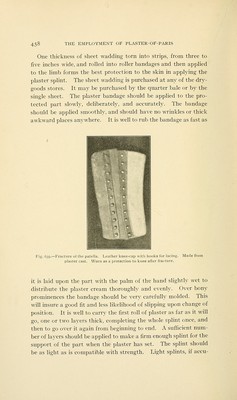
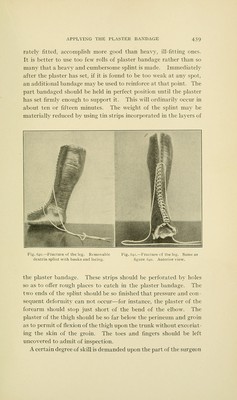
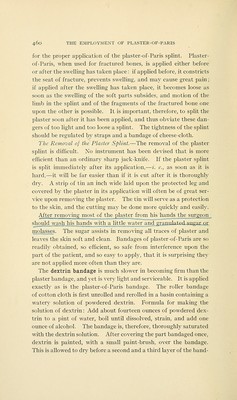
![the hands still grasp its ends. The bandage should be wrung until it does not drip. In the application of the plaster splint to frac- tures of any part of the body it is ini]ic)rtant that all deformity should be corrected and that the part should be thoroughly immo- bilized. This necessitates the presence of one or two assistants. In applying a plaster splint with the roller bandage the surgeon Fig. 638.—Ham splint of plaster-of-Paris. The splint is slightly thicker at the ham underneath the region touched by the thumb in the plate. It is thus strengthened. More comfortable than ordinary wooden ham splint. should do his work so carefully that he scatters no plaster any- where but upon the splint and in the pail of water. The surgeon should work neatly. The patient should be protected by a sheet. The floor should be protected by a sheet spread under the patient and under the chair of the smgeon. The surgeon should remove his coat, roll up his sleeves, and be protected from unexpected spattering of plaster by an apron or sheet over his body.](https://iiif.wellcomecollection.org/image/b21207689_0465.jp2/full/800%2C/0/default.jpg)