Appendix B to the report of the Commissioners appointed to inquire into the condition of all mines in Great Britain to which the provisions of the Act 23 & 24 Vict. Cap. 151 do not apply, with reference to the health and safety of persons employed in such mines. / Presented to both houses of Parliament by command of Her Majesty.
- Great Britain. Royal Commission on Mines
- Date:
- 1864
Licence: Public Domain Mark
Credit: Appendix B to the report of the Commissioners appointed to inquire into the condition of all mines in Great Britain to which the provisions of the Act 23 & 24 Vict. Cap. 151 do not apply, with reference to the health and safety of persons employed in such mines. / Presented to both houses of Parliament by command of Her Majesty. Source: Wellcome Collection.
Provider: This material has been provided by Royal College of Physicians, London. The original may be consulted at Royal College of Physicians, London.
14/526 (page 11)
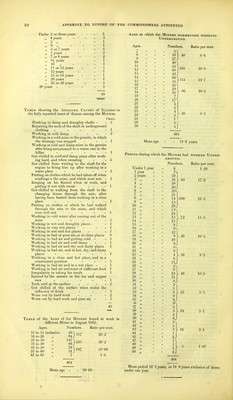
![Table showing the State of the Miners found AT Work. Ages. Number ex- amined. Healthy. Pale. Worn. Decidedly deli- cate looking. Complaining of various symp- tons of indis- position.* TTiiHor 91 UIlUvl ill 117 42 36 2 32 V 5 ^ 35-8 p. c. 80= =68'3 p. c. 37 = 31'6 p. c. 21 to -10 233 112 45 14 45 17 48-06 p.c. 171 =7 3-3 p. c. 62= 26 6 p. c. 41 to 63 111 43 8 1 33 29 37'7 p. c. 52 = 45'6 p. c. 62 = 54-3 p. c. 464 197 89 1 17 110 51 42'4 p. C. 803= =65-3 p.c. 161 =34,-6 p.c. ' Dyspeptic and rheumatic sj'mptoms, cough, expectoration, difficulty of breathing, paI))itation, &c., with more or less marked general appear- ance of debility or indisposition. 10 Case of Miners' Diseape examined after Death. John Francis, at 55, under the care of Henry Harris, of Redruth. He was rejjorted to have worked underground at various mines, Carn Brea, Wlieal Bassett, Wheal Bidler, Tin Croft, and East Pool, and commenced working when 13 or 14 years of age. At first he did hoys'-work, assisting the men, rolling the trucks underground, &c. After he did full men's work he had chieHy been employed at tutwork. His illness was ascribed by his friends to his having worked in 20 damp and wet places and in bad air. For five years before his death he had been out of health, suffering from difficulty of breathing, cough, and expectora- tion, and pains in the chest. He continued to work at the mines for three years after these symptoms first appeared, but for two years he had not been able to go underground, and had been employed in a drying room attending to the men's clothes. Latterly he complained of pain in his right side, which prevented his lying on that side, and he had also a swelling of the right thigh. He generally expector- 30 ated white matter, but had brought up blood. His father was a miner, and died of miners' disorder after an illness of two years' duration, when (i/ years of age. His mother died at the age of (JO of strictiire of the CESophagus. He never had any brothers, but had three sisters, of whom one died at G3 of consumption ; the other two are alive at 60 and 68 years of age. He was not a very steady man, having been addicted to drinking. For these particulars I am chiefly indebted to Mr, Harris. 40 The post mortem examination was performed by Mr. Bankart and myself, about 24 hours after death. The body was moderately emaciated. The left lung was voluminous, perfectly black on the surface, and adhered by old attachments in the mammary region, and the pleura in the seat of the adhesions was thick, white, and solid. The substance of the lung was very sparingly crepitant, and of a deep blue or black colour. It dia not contain any tubercles ; a peculiar brown coloured secretion was found in the smaller bronchial tubes. The edges of the lung in 60 front were somewhat em])hysematous. The right lung was universally adhered to the parietes by firm fibro-cartilagi- nous attachments. The third rib was carious, and an abscess existed in that situation which presented externally, and had separated the rib from the pleura. The abscess contained a considerable quantity of thick yellow pus mixed with cheesy matter. The right lung was of a deep blue colour, and solid every- where except at the upper part, where there existed several irregular cavities containing brown coloured fluid sirr ilar to 60 that found in the bronchial tubes of the left lung. The bronchial glands were large, very solid, and of a deep black colour. The trachea was considerably wider than natural, but the larynx was free from ulceration. Shortly above the bifur- cation of the bronchi, and at the bifurcation and for a short distance along the right bronchus, the mucous membrane was studded with small specks of yellow-coloured lymph. Under these the mucous membrane was not abraded or otherwise altered. 70 The heart was of large size, and probably weighed from 10 to 104 oz. avoird. The pericardium was somewhat loose, the cavities large, and the walls moderately thick and flaccid, and the whole organ appeared as if atrophied. The valves were dyed by hlood from decomposition, but free fi-om disease. The aorta and pulmonary arteries were both very considerably dilated, but the coats were of natural thickness and free from deposit. The liver was partially attached to the diapnragm by old cellular adhesions, and its structure was dense, coarse and resistant. 80 The kidneys were easily deprived of their tunics, and the surfaces of the organs when exposed were smooth. The cortical portion was rather narrow ; one of the supra-renal capsules was so completely atrophied as to consist of little more than cellular tissue. The other was converted into a mere cyst with thin walls and with a rough and dark surface in the interior. The stomach was healthy, and the intestines apparently free from any disease. The brain was not examined. 90 Note on the fever cases visited at St. Just with Mr. Searle. The epidemic commenced in the spring in cottages sur- rounding the church, the churchyard being raised several feet above the adjacent ground. From this part the disease spread from cottage to cottage up the valley for upwards of a mile. The disease had the characteristic symptoms of typhoid-diarrhoea, tympanitic distension of the abdomen, &c., and Mr. Searle in all five lost patients. In one case a young woman who was ill near the church, was visited by her sweetheart, who took the disease 100 though residing in an entirely different district. The same young woman was nursed by a sister who came from a cottage about a mile distant, after about a fortnight she became ill, went to her own house, and spread the disease to others there, though no case had previously occurred. The epidemic had to a considerable extent subsided when I was there; but Mr. Searle took me to two cottages forming one block of building in which there were still cases. These cottages were situated on an open moor 200 or 300 feet above the sea, exposed in every direction, with a dry, 110 shallow and rocky soil covered with heather, the sea being about 2 miles from it. In point of situation nothing could have been healthier, yet the state of the cottages was most wretched. They were surrounded by shallow pools of water, covered with « green slime, were not provided with any under-drainage or with privies, and all the refuse was thrown out on dust heaps situated in front of the doors and on the south sides of the cottages. One of the cottages was inhabited by a butcher who killed his meat on the spot. \20 The cottages were built of rough stone and covered with the heavy slabs which are obtained in the district; they con- sisted of three rooms each, one below and two above, and each had a small window oj)ening N. and S. The floors of the lower rooms were on the level of the adjacent soil, and were paved with slabs of stone; the upper rooms were open to the slanting roof. The disease first occurred in the cottage of the butcher, and I could not ascertain that there was any reason to suppose that it was imported. It commenced in April, |30 affected four children from 9 to 21 years of age, and ceased in July; all the in^'alids were out when I called. From this house a young man who visited there at the time took fever, and spread it in his own neighbourhood at a distance. In the other house the disease appeared also about the middle of April, and two children first attacked were convalescent, but still thin, pale, and very delicate looking when I saw them. They were aged 12 and 5 years, and had been respectively ill four months and nine weeks, so they must have sickened about the 21st of April, and the 5th of 140 June. Their mother, aged 38, had had two attacks, the last seven or eight weeks before, and was pretty well again. Two children were still lying ill in the same bed, but ap- proaching convalescence, one at 14 had been ill two weeks, and the other at 12, twelve days. In both there was the usual flushed face and torpid expression of countenance, though they were capable of being aroused to protrude the tongue; they were both deaf. In each case the tongue was dry and somewhat brown, the skin harsh and dry, and the remains of Several characteristic tyjjhoid spots were detected. The 150 abdomen was tumid, and there had been more or less diarrhoea. The pulse was feeble and somewhat quick. The general condition of the cottages in this neighbourhood was extremely bad. In ■ cottage by Treweller Chapel there were nine persons residing, a son and daughter being quite grown up. It consisted of tln-ee small rooms, vidth little windows which did not open, had a slanting roof above, and was low and thatched, paved with stones below, and with no under-drainage, and no privy. The state of cottage was much the same, as well as [fin that of several others which I visited in the church town; indeed in answer to special inquiries I found that there was never any under-drainage and seldom any privies to the cot- tages ; and on the inquiry where the refuse was thrown, a heap of rubbish was pointed out lying undisturbed iu front or at one side of the door. The cottages at Bosorn, to the S. E. of St. Just church town, were perhaps the worst in the whole district. 2](https://iiif.wellcomecollection.org/image/b23983292_0015.jp2/full/800%2C/0/default.jpg)